Professional oboist and chamber musician- member of Hevreh Ensemble and Winds in the Wilderness, Professor of Oboe Hofstra University; observer of people, art and nature; passionate food and travel explorer.
On a cool and cloudy day, we took a short walk at the Joffe Nature Sanctuary in New Marlborough, Massachusetts. My eye caught a lone maple leaf floating gently on the shallow marsh pond.
As we strolled on the trail that loops around the idyllic marsh, we composed haikus about the leaf. Here is what we came up with (mostly my husband Paul’s invention!)
Leaves in the pond-light
Life dances around us, bright
Time flows, a grace note
At the end of the loop, we returned to the pond to check out our lone maple leaf- it was now joined by four leaves; the sun had broken through the clouds. The light had changed the image dramatically.
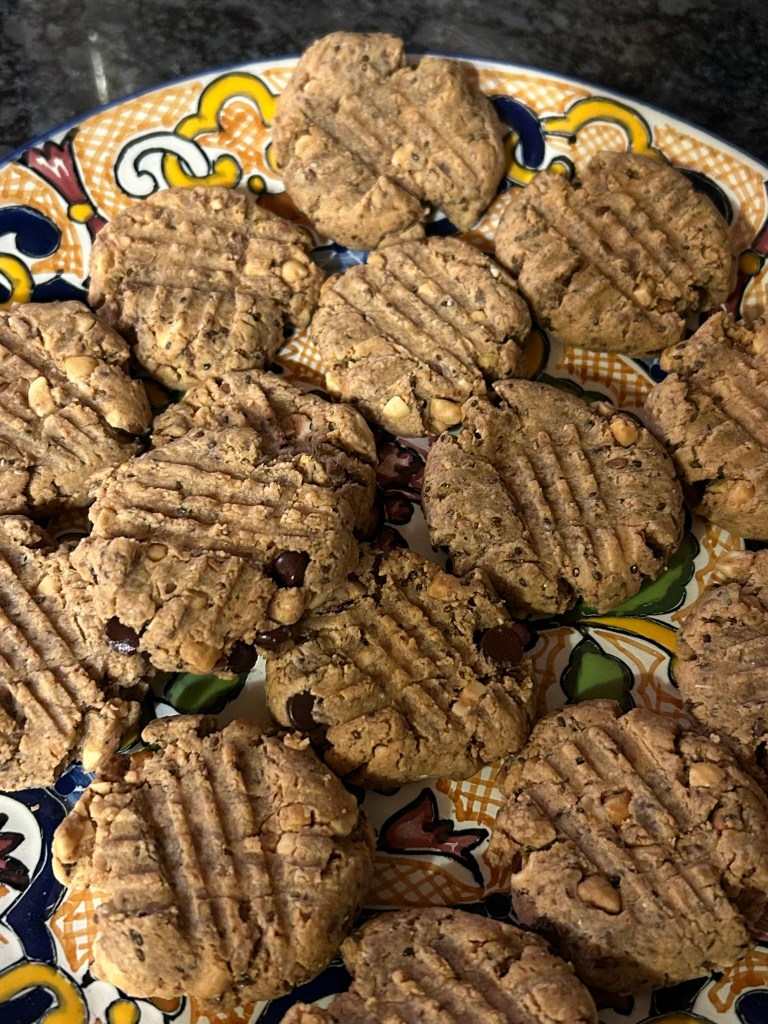
That afternoon, the cool weather put me in the mood for baking and I thought of the vegan peanut butter cookies from the cozy Woodstar Cafe in Northhampton, MA. Those cookies and iced chai were my special treat during Covid and one of my best mood elevators. After eating many of these treats, I decided to try to concoct my own version and originally published it in a blog post in December 2021: “Hemlock Heaven and Bear Swamp”. The ingredients are healthy and include almond flour, ground flaxseed, chia seeds, chunky peanut butter, vanilla and maple syrup. You can also add chunks of dark chocolate. They are chewy, delicious and slightly addictive. I hope you enjoy making these!
EASY One Bowl Vegan Peanut Butter Cookies
Pre-heat oven to 350
Line a large baking sheet with parchment paper
Ingredients:
1 cup crunchy peanut butter* see note
1/4 cup maple syrup
1 teaspoon vanilla
3/4 cup almond flour
1/4 cup ground flax seed
handful chia seeds
1 teaspoon baking powder
1/4 cup soy milk of mixture is too dry.
To make cookies:
In a medium sized bowl, mix together peanut butter, maple syrup and vanilla. Combine well with a large spoon.
Add almond flour, ground flax seed and baking powder. Mix well, the batter will be stiff, but not dry.
If the mixture is too crumbly, add about 1/4 cup soy milk.
I like to get my hands into the batter and form the dough into a large ball. It should feel like the consistency of play dough!
Form batter into small balls- I made 15, but you could make fewer larger cookies.
Press gently with a fork to make a criss cross pattern.
Bake in middle of oven for about 1o minutes until the bottoms of the cookies are light brown- the cookies will still feel quite soft.
Note* I used peanut butter that was salted. If you use an unsalted brand, add about 1/2 teaspoon salt to the batter.
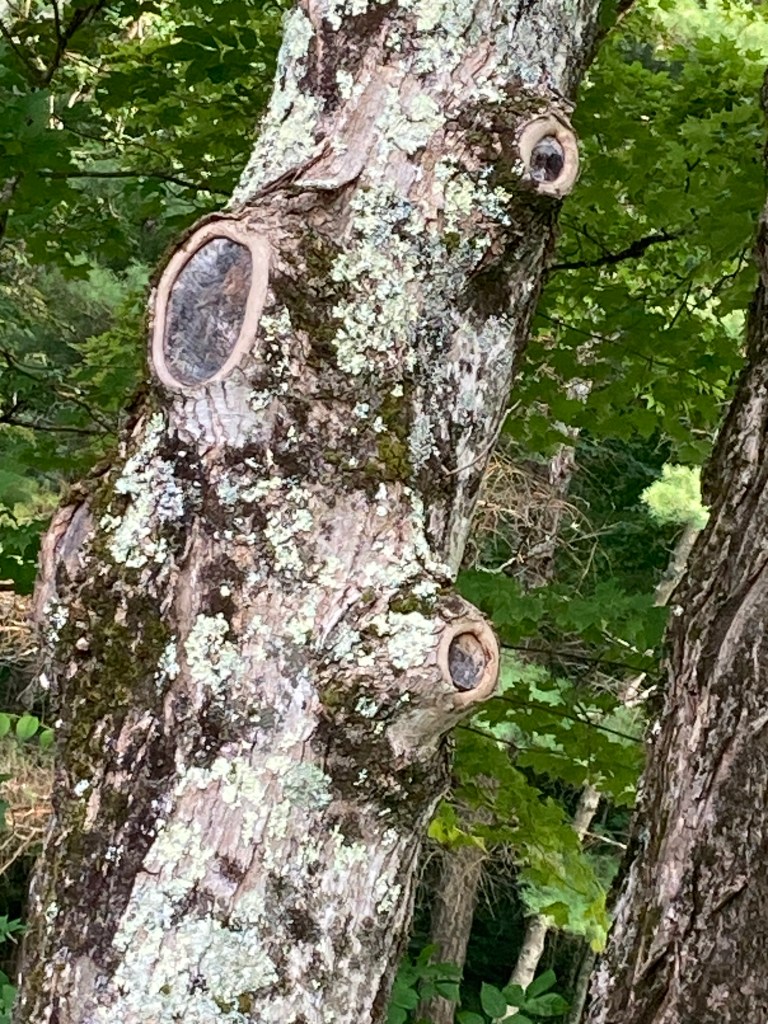
AND: Here is the “Tree of the Week”
” Not Sure it’s Safe Out There“Joffe Nature Sanctuary
April 21st- The last few weeks have been rainy, raw and windy; a slow start to spring. So, when the sun finally peeked tentatively out, I made room in my schedule to head out for a hike at the Drury Preserve in Sheffield, Massachusetts.
This time, I remembered to pay attention to my surroundings! As I entered the woods, I breathed in the rich piney air and happily headed off on the familiar sun dappled trails. It felt as if I had come home.
As I continued on my walk, my thoughts turned to music and to upcoming changes in my musical career. Thursday, April 24th at the FDR Presidential Library and Museum, will be my last performance with The Hevreh Ensemble; a group that I started over 20 years ago! I thought of our many trips to Europe and having the chance to travel to Iceland- wonderful memories. No regrets here, but bittersweet thoughts of leaving the group. I have decided to devote more of my musical energy to Early Music and performance on the Recorder.
And, I look forward to writing future blogs about some of the trips that Hevreh Ensemble took to Prague, Vienna, Krakow , Berlin, Amsterdam and Warsaw!
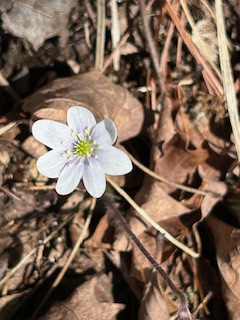
I walked past a beautiful meadow and was quickly brought out of my reverie; on the small hillside next to me, I noticed one of the first woodland flowers of spring, Blunt Lobed Hepatica.
As I looked my closely, I saw small bunches of the flowers clustered all over the surrounding area.
Tiny speckled leaves of Trout Lilies peaked shyly out of the ground.
As I was finishing my walk, my thoughts had turned to making Matzoh Ball Soup for our upcoming Passover Seder. I did pay attention to where I was going and I am happy to report that this time, I did not get lost. I retraced my steps to my car without any mishap!
Each year, we look forward to sharing Passover with dear friends; cooking a large traditional meal that always includes Matzoh Ball Soup. Over the years, I have come up with a recipe for matzoh balls that are light and also flavorful. I make a rich chicken stock with diced carrots and a touch of dill- together this soup shared with friends is truly an antidote for our crazy world!
ENJOY!!
Matzoh Balls (Adapted from Bon Appetit Magazine- August 20, 2004 issue)
Ingredients:
4 large eggs, separated
1 teaspoon salt
Dash cayenne pepper
2 teaspoons white onion, grated
2 tablespoons unsalted butter, melted ( I use Extra Virgin Olive Oil and it works just as well)
3/4 cup matzoh meal
Preparation:
In a medium bowl, beat the egg whites until they hold stiff peaks; set aside. In a large bowl, whisk together the egg yolks, salt, cayenne pepper, onion, and olive oil. Fold the egg whites into the egg yolk mixture until just combined. Gently fold in the matzoh meal in several additions. Cover bowl with plastic wrap and refrigerate one hour. In a large pot, bring water to a boil. Moisten hands with cold water and roll the matzoh mixture into 3/4 inch balls. After all the balls are formed, drop them into the boiling water. Return to a boil, then reduce heat. Cover and simmer for 30 minutes. Remove with a slotted spoon. These freeze beautifully- let cool completely and then place in a large plastic container. To use, defrost slowly at room temperature and then place in chicken stock and heat. I like to add diced carrot and fresh dill to the soup.
RICH CHICKEN STOCK
Ingredients:
1 whole chicken (about 3-4 pounds)
1 large onion peeled and cut into 4 pieces
1 large stalk celery- cut into 3-4 pieces
1 large carrot- peeled and cut into 3-4 pieces
1 bay leaf
1 teaspoon dried thyme
15 whole peppercorns
1 teaspoon dried dill
1 tablespoon salt
TO MAKE CHICKEN STOCK:
Place all ingredients into a large stock pot
Cover with cold water
Bring to a boil- remove any scum that may rise to the top, reduce to a simmer. Cover pot and simmer about 3 hours.
Let cool completely- pour into a large bowl and refrigerate overnight. The next day remove fat from top. The stock can now be used or frozen.
It’s the end of winter; last week the roads and paths on our walks were still icy and the wind had a bitter bite.
We are hearing more birds, the light is bright and the air smells sweet- spring feels like it is just around the corner.
I love cookbooks and have way too many. The shelves in the pantry are lined with dog eared and batter smudged cookbooks and the bookshelves in our living room are lined with cookbooks that were once eagerly read and and since have become ignored.
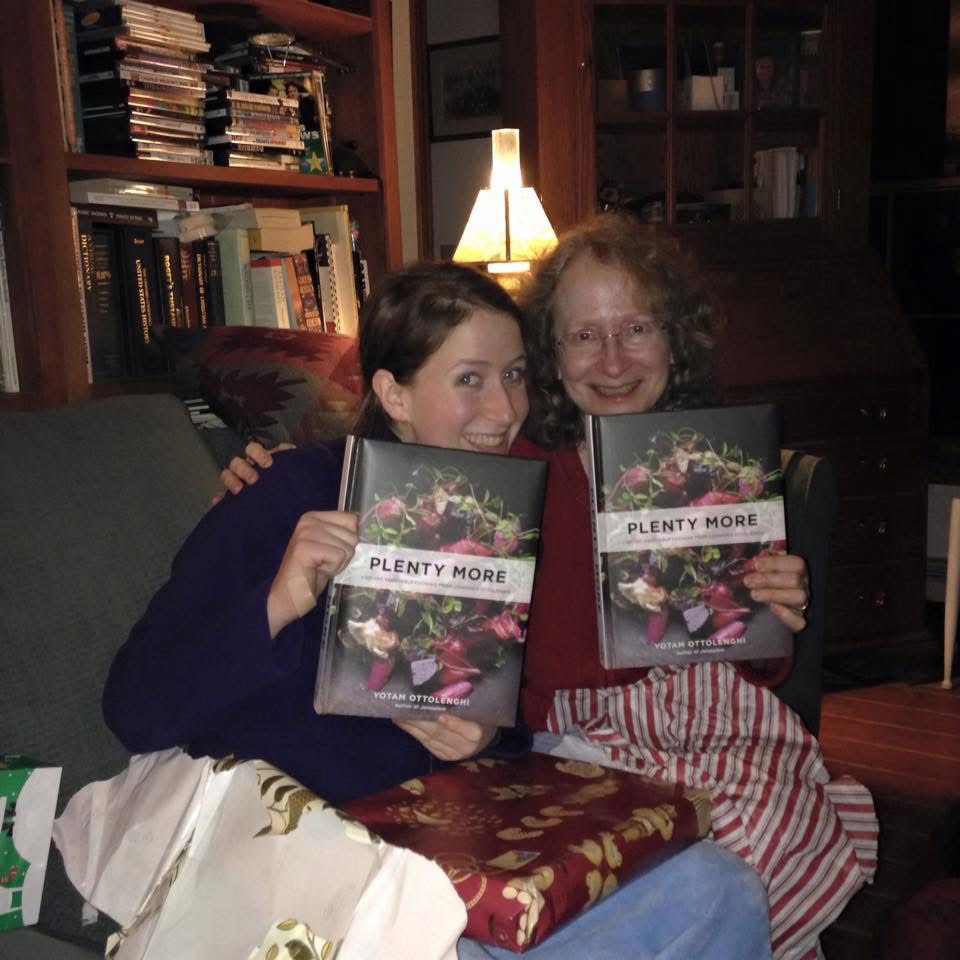
One of my favorite food writers is Yotam Ottolenghi, an Israeli born British chef. His recipes are deeply flavorful and creative. A few years ago for the holidays, my daughter and I surprised each other with the same Ottolenghi book!
Lately, when I come downstairs in the morning, I have discovered several volumes of cookbooks opened up to enticing looking recipes- little suggestions from someone??
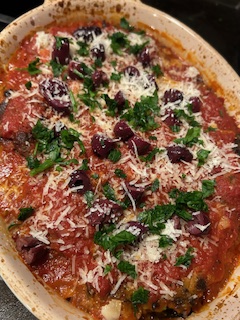
One of the books was opened up to page from Ottolenghi’s book, Flavor. The recipe for Eggplant Ricotta Dumplings looked delicious and even though the recipe included ricotta and parmesan cheese, it did not look too rich.
The recipe had several steps, but was not difficult and the resulting dish was well worth any extra effort.
Roasted eggplant was combined with ricotta, eggs, parsley, fresh breadcrumbs, garlic and basil, formed into oval shaped dumplings and baked in a light paprika inflected tomato sauce topped with kalamata olives and basil. It tasted like a combination of eggplant parmigiana and baba ganoush. A few portions were leftover; the flavors melded overnight and were delicious the next day!
Eggplant Ricotta Dumplings ala Parmigiana (from Yotam Ottolenghi’s book, Flavor
1 1/2 cups/90g fresh breadcrumbs, ideally sourdough 4 eggplants, cut into roughly 2½cm cubes (1kg net weight) 1/2 cup plus 2 tablespoons/150ml olive oil Salt and black pepper 6 tablespoons/100g ricotta 2/1/12 ounces/75g parmesan, finely grated, plus extra to serve 2½ tbsp parsley leaves, finely chopped 1 whole egg, plus 1 yolk extra 1½ tbsp plain flour 6 garlic cloves, peeled and crushed 4 tbsp basil leaves, roughly chopped- I did not have basil on hand- chopped parsley worked well! large can peeled plum tomatoes , blitzed smooth 1½ tsp tomato paste 1½ tsp sugar– I omitted sugar in my version ¼ tsp chili flakes ¾ tsp paprika 2 tsp fresh oregano leaves, finely chopped
1 1/2 cups/ 400 ml water 1/3 cup/45g pitted kalamata olives, torn in half
Heat the oven to 350F/160C. Spread out the breadcrumbs on an oven tray and bake for 12 minutes, until lightly browned and dried out. Remove, leave to cool and turn up the oven to 450F/220C.
On a large oven tray lined with baking paper, toss the eggplants with 5 tbsp/ 75ml oil, half a teaspoon of salt and a good grind of pepper. Spread out on the tray, bake for 30 minutes, tossing once halfway, until golden brown, then chop into a chunky mash and put in a large bowl. Mix in the ricotta, parmesan, parsley, egg, extra yolk, flour, breadcrumbs, a third of the garlic, two and a half tablespoons of basil, a quarter-teaspoon of salt and a good grind of pepper. With lightly oiled hands, shape the mix into 16 golf-ball-sized dumplings, each weighing about 2 oz/ 55g each, and compress so they hold together.
Heat two tablespoons of oil in a large, nonstick frying pan on a medium-high flame, and fry half the dumplings for three to four minutes, turning them until golden brown all over (adjust the heat if they’re browning too much), then transfer to a plate and repeat with the rest of the dumplings.
Heat the remaining two tablespoons of oil in the same pan, fry the remaining garlic for a minute, until fragrant, then stir in the tomatoes, tomato paste, sugar, chilli, paprika, oregano, a teaspoon of salt and a good grind of pepper, and cook, stirring occasionally, for eight minutes, or until thickened slightly. Pour in 400ml water, bring to a simmer, then lower the heat to medium and simmer for 10 minutes. Add the dumplings and cook for 15 minutes, or until cooked through.
Remove from the heat, scatter over the olives, the last of the basil and a grating of parmesan, and serve straight from the pan.
A thick blanket of snow fell overnight and as I write this blog, ice is decorating pine needles and branches of the trees. We made a decision to stay cozily inside with a warm fire in the woodstove.
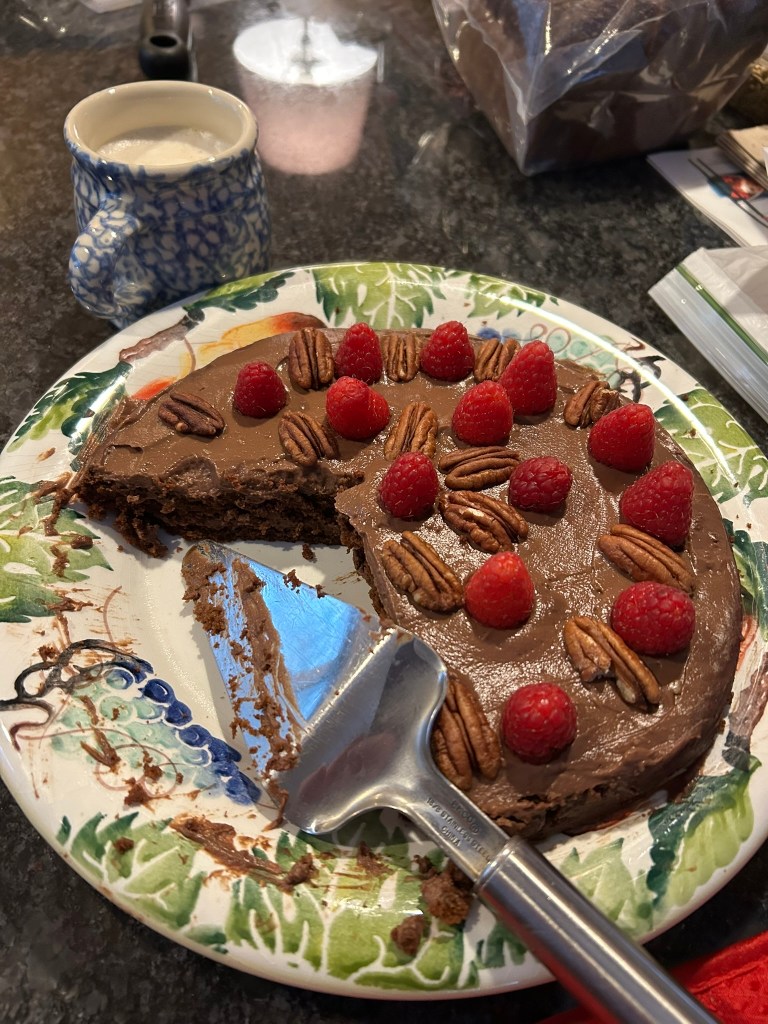
All week long, I had been craving chocolate desserts, wanting to dive into a slab of fudgy rich chocolate cake slathered in ganache. I remembered an easy one dish vegan chocolate cake filled with chocolate pudding that I featured in a February 2022 post. It was easy to make, tasted completely decadent and best of all was made with stevia, coconut sugar and with no eggs or butter.
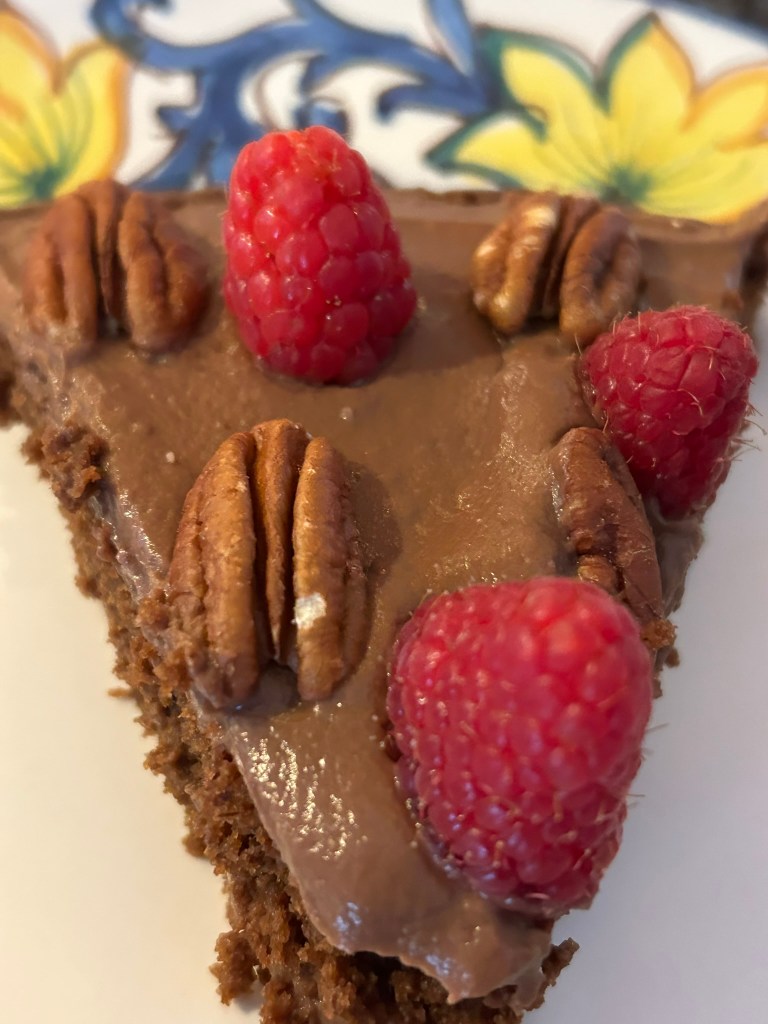
This is what I made today and we just finished big slices that were decorated with fresh raspberries and toasted pecans. It was fudgy, moist and tasted very rich. We enjoyed it with 2 mugs of frothy decaf Cafe au Lait- a perfect guilt free treat for a snowy day!
Snowy Day Chocolate Pudding Vegan Chocolate Cake
Cake Ingredients:
1 ½ cups whole wheat pastry flour
1/2 cup coconut sugar
¼ cup cocoa powder
1 teaspoon baking soda
½ teaspoon salt
⅓ cup vegetable oil
1 teaspoon vanilla extract
1 teaspoon distilled white vinegar*- see note
1 cup water
To Make Cake:
Preheat oven to 350 degrees F (175 degrees C). Lightly grease and line one 8×10 cake pan with greased wax or parchment paper.
Sift together the flour, sugar, cocoa, baking soda and salt. Add the oil, vanilla, vinegar and water. Mix together until smooth.
Pour into prepared pan and bake at 350 degrees F (175 degrees C) for about 25-30 minutes. Do not overbake, the cake should remain soft and fudgy. Remove from oven and allow to cool.
Remove cake from pan, peel off wax paper and place on rack to cool.
Chocolate Pudding Filling– adapted from Chocolate Cake by Michele Urvater
Ingredients:
1/4 cup cornstarch
1/3 cup coconut sugar or monk fruit ( this makes a very bittersweet pudding, feel free to add up to 1/2 to 3/4 sweetener.)
1 1/2 cups unsweetened almond or soy milk
1/2 teaspoon almond extract
4 ounces dark chocolate chopped (I used Equal Exchange Extremely Dark chocolate, but you could semi or bittersweet chocolate for a sweeter taste)
To make the pudding:
In a small mixing bowl, with a fork or small whisk, combine the cornstarch with 1/2 cup of the milk.
In a small saucepan over low heat, bring the remaining 1 cup milk to a simmer with the sugar, stirring occasionally so the milk does not boil over. Remove the saucepan from the heat.
Whisk the cornstarch and milk in the bowl again to make sure the cornstarch is dissolved, and add this to the hot milk and sugar mixture. Return the saucepan to the heat and bring to a simmer until the mixture thickens, whisking constantly. Remove from the hear and add chocolate, stirring until chocolate melts into the mixture. Stir in almond extract. Put pudding in a bowl and refrigerate until cold.
To fill the cake:
Carefully slice cake with a serrated bread knife in half and place one piece on a plate. Spread half of pudding mixture and place other half on top.
Spread remaining pudding on top and decorate with raspberries and toasted pecans. This would also be nice to decorate with sliced strawberries and chocolate chips.
* I was curious to find out why vinegar was called for in the recipe. For the kitchen science geeks, it turns out that vinegar reacts with baking soda to create a chemical reaction that makes the crumb of the cake light and tender!
Outside the Clark Art Institute in Williamstown, Massachusetts, the hills in the distance were gray and foreboding and the wind chill was sharp and bitingly cold; what better time to be inside!
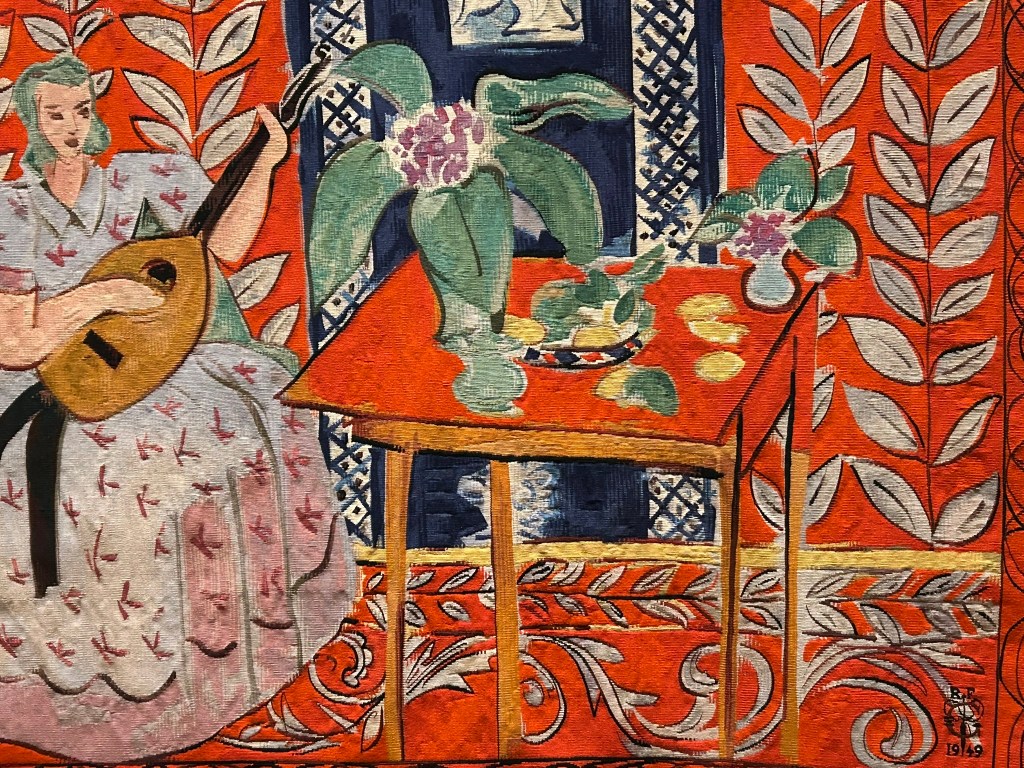
We were delighted to discover a special exhibition at the Clark: Wall Power! Modern French Tapestry from the Mobilier national, Paris. The exhibit displayed a wide range of tapestries created by contemporary artists from the 1920’s to today. Artists, weavers and dyers revived ancient techniques and created bold and daring new works of art. The room was full of brilliant colors and patterns; warming to the soul.
The beautifully curated exhibit included the following insightful commentary:
“Since the middle of the 20th century, the art of tapestry has continued to offer a vast field of expression to major artists, to the most varied trends and plastic research: Picasso, Matisse, Miró, Delaunay, but also to abstract artists (Hartung, Vasarely) non-figurative (Nemours, Bazaine), part of Minimal Art, new realism (Hains), narrative figuration (Erro, Aillaud) or the Supports-Surfaces group (Buraglio, Rouan, Pincemin). More recently, Louise Bourgeois, Bertrand Lavier, Sheila Hicks or Orlan have distinguished themselves with their woven creations. In perpetual evolution, the works created by the Manufactures nationales reflect the most diverse trends in contemporary art”.
“A Thousand Wildflowers” by Dom Robert, a Benedictine Monk, recalled wildflower fields that were popular in the Middle Ages.
“A Thousand Wildflowers”- Dom Roberts (1907-1997)
Several of the tapestries were designed from existing works of art and then woven. Designing a work and then weaving it with a team of weavers, can take up to 2 or 3 years.
“Swallow Love”- Joan Miro (1893-1983)“Evening Music“-Pauline Peugniez-1890-1987“The Woman with the Lute”- Henri Matisse (1869-1954)“The Vines of Volnay”- Michel Tourliere (1925-2004)
The French artist Michel Tourliere who lived from 1925-2004, came from wine country in Burgundy and specialized in designing woven tapestries. His works often depict landscapes from Burgundy.
We also viewed stunning contemporary works by the American artist Kiki Smith and the French artist Jean Messagier.
“Seven Seas”- Kiki Smith (American-born Germany 1954)“Red Flames”- Jean Messagier (1920-1999)
At the end of the exhibit, it was fascinating to see the back of “Red Flames”; a work of art in itself!
And then, back home for some hearty soup!
I had roasted a chicken with basil pesto slipped under the skin and was looking for a use for the leftover chicken. I decided to make a quick stock with the remaining chicken carcass. I threw the chicken bones along with a carrot, onion, celery, thyme, peppercorns, salt and bay leaf into a big pot, covered it with water and let it simmer on the stove for a few hours and then strained the stock and discarded the solids. The result was a delicate basil scented stock, just right for beans and kale! I defatted the stock and added chopped, onion and carrot, a can of white beans and a small bunch of chopped lacinato kale. Along with bay leaf, dried thyme, dried sage and dill, I simmered the soup until all of the vegetables were tender. I added leftover chopped chicken and a small package of cooked tortellini. Sprinkled with freshly ground pepper and grated pecorino cheese, this was truly a heartwarming winter soup! ENJOY!!
Pesto Chicken, Kale, White Bean and Tortellini Soup
Ingredients for Pesto Chicken Stock
Leftover chicken bones
3 quarts water
one onion cut in half
1 large carrot roughly chopped
1 stalk celery with leaves roughly chopped
1 clove garlic peeled and smashed
2 teaspoons salt
10-12 whole peppercorns
2 teaspoons dried thyme
2 bay leaves
Ingredients for soup:
3 quarts defatted pesto chicken Stock (home made is best, but you can use store bought and add a tablespoon of pesto)
1 tablespoon extra virgin olive oil
1 medium carrot chopped
1 onion chopped
1 stalk celery chopped
leftover chicken cut into small pieces
8-10 lacinato kale leaves
1 can cannellini or great northern beans, drained and rinsed
1 teaspoon dried thyme
1 teaspoon dried sage
1 teaspoon dried dill
1 bay leaf
1 small package tortellini (I used Kite Hill tortellini with almond milk ricotta)
To Make Soup:
In a large pot, heat olive oil and add chopped onion. Saute a few minutes until onion softens. Add chicken stock and all other ingredients, except tortellini and cut up chicken.
Bring to a boil and then reduce to a simmer. Cook covered about an hour until vegetables are very tender. Cook tortellini according to directions on package and add to soup along with the leftover cut up chicken.
Serve with freshly ground pepper and sprinkle with grated pecorino cheese!
Christmas at Thousand Acre Swamp-New Marlborough, MA
The New Year is upon us; the last few weeks have been a happy blur of visits with dear friends and family. We have enjoyed wonderful meals together for both Christmas and Hanukah. This blog will feature a festive fruit tart that we served for Christmas and delicious chocolate and apricot rugelach that our daughter Lev made to celebrate Hanukah. Luckily we were able to go on a few hikes to work off the rich food!
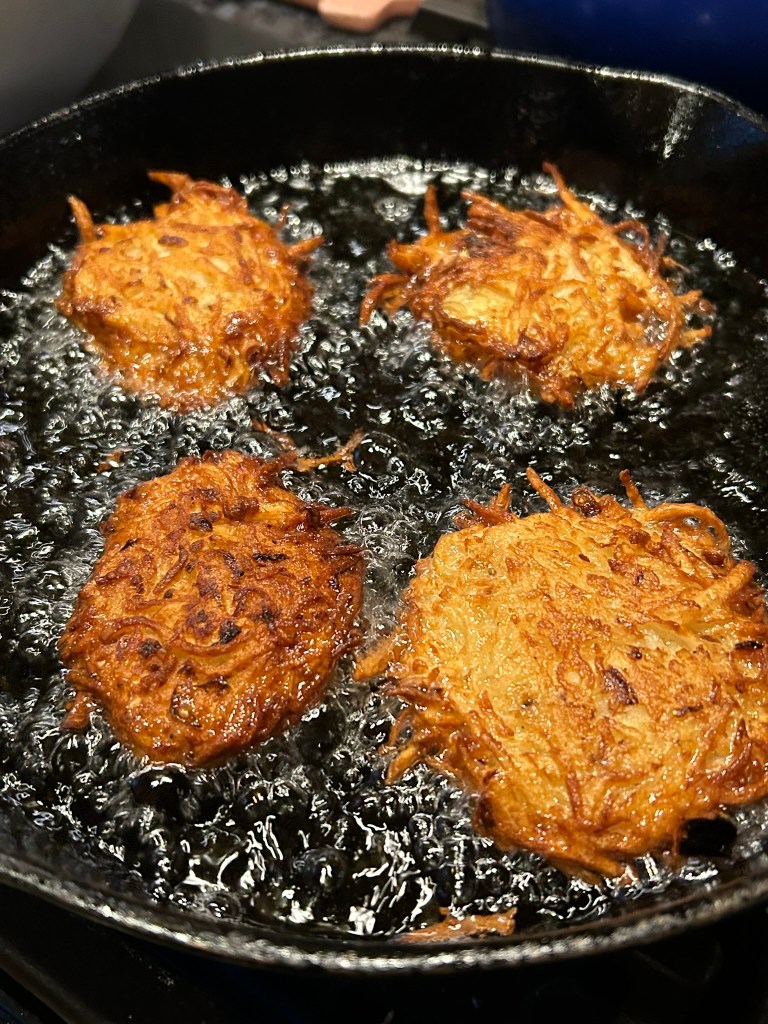
Hanukah Latkes!!
One day, we walked at a a favorite place; Thousand Acre Swamp in New Marlborough, Massachusetts with serene trails that wind through pine forests and overlook a beautiful swamp.
Thousand Acre Swamp
Delicate princess pines peeked demurely through a light cover of snow.
Thousand Acre Swamp
Another day we enjoyed a late leisurely breakfast at the newly reopened Roadside Diner in Monterey, MA. The diner is operated by Gould Farm, a therapeutic community. Just down the road is the lovely 1.5 mile Diane’s Trail that winds through Gould Farm, along a wetland habitat and the Rawson Brook.
Diane’s Trail, Gould Farm- Monterey, MA
As we walked alongside the marsh, sunlight sparkled on the ice.
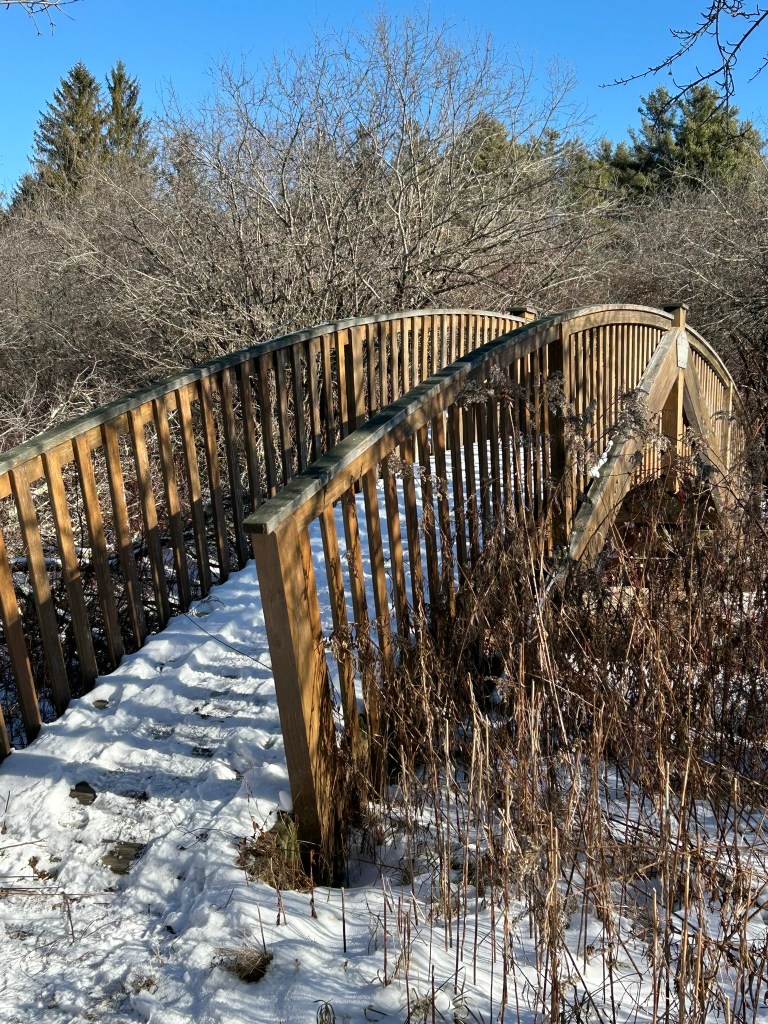
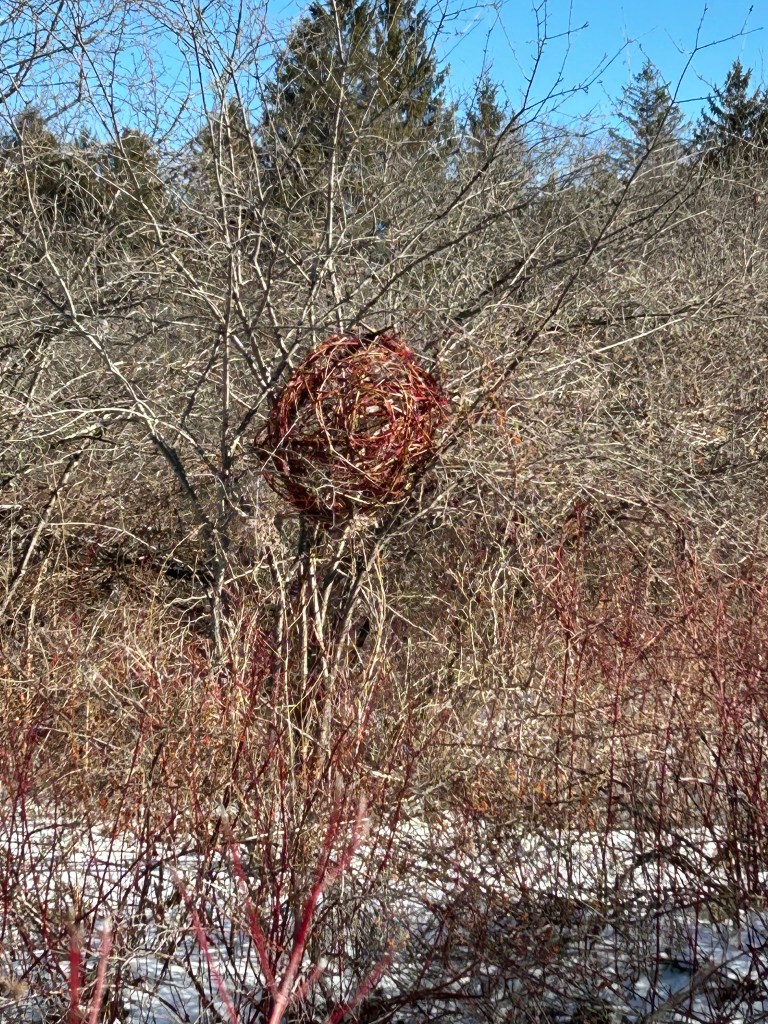
We trekked over a wooden bridge and saw what we thought was a large bird’s nest, made from branches lining the sides of the brook.
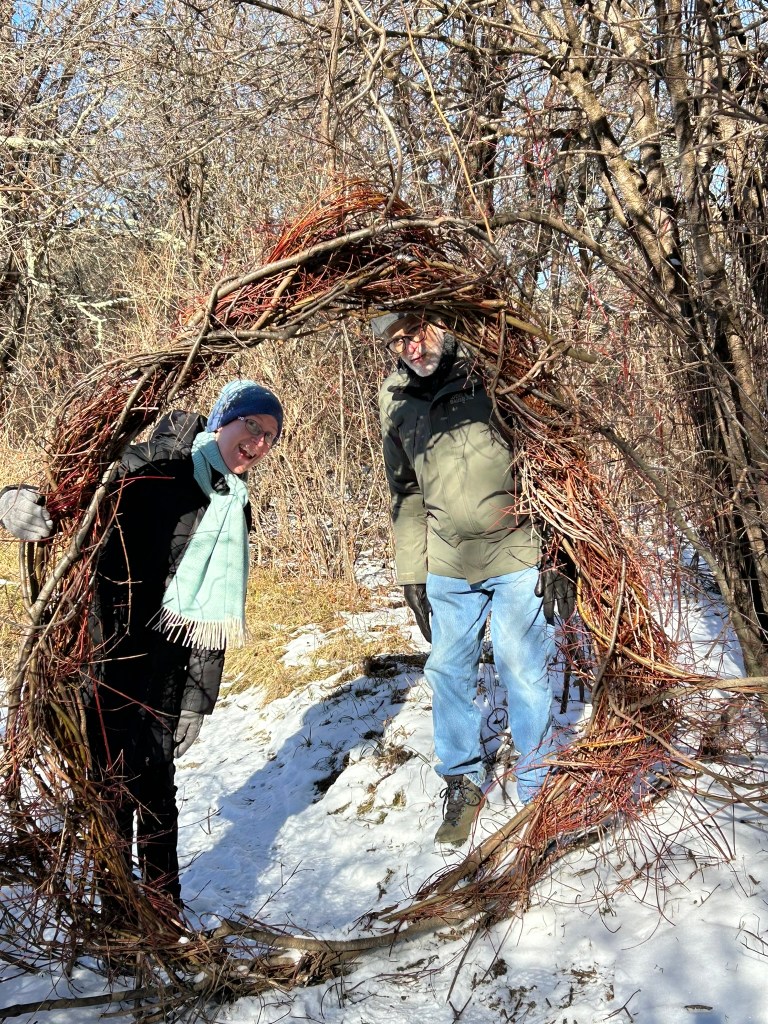
A bit further on, we came upon another branch sculpture that was definitely made by people or a large creative bird!
Diane’s Trail-Gould Farm
Back out of the cold, we returned home to our baking projects.
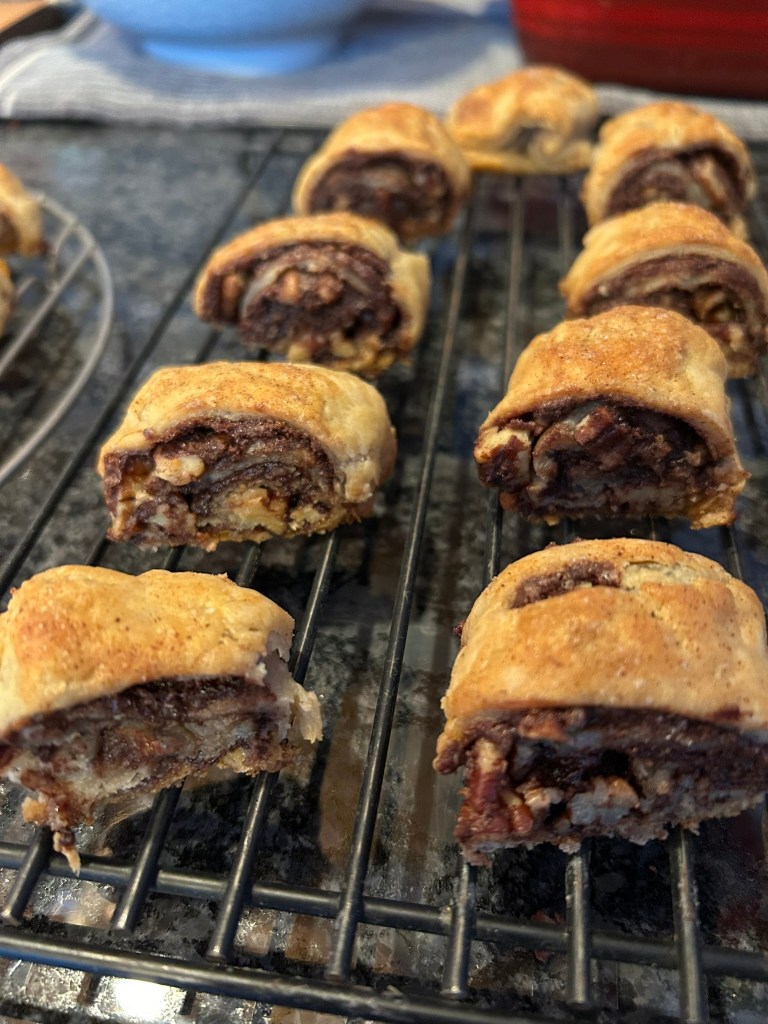
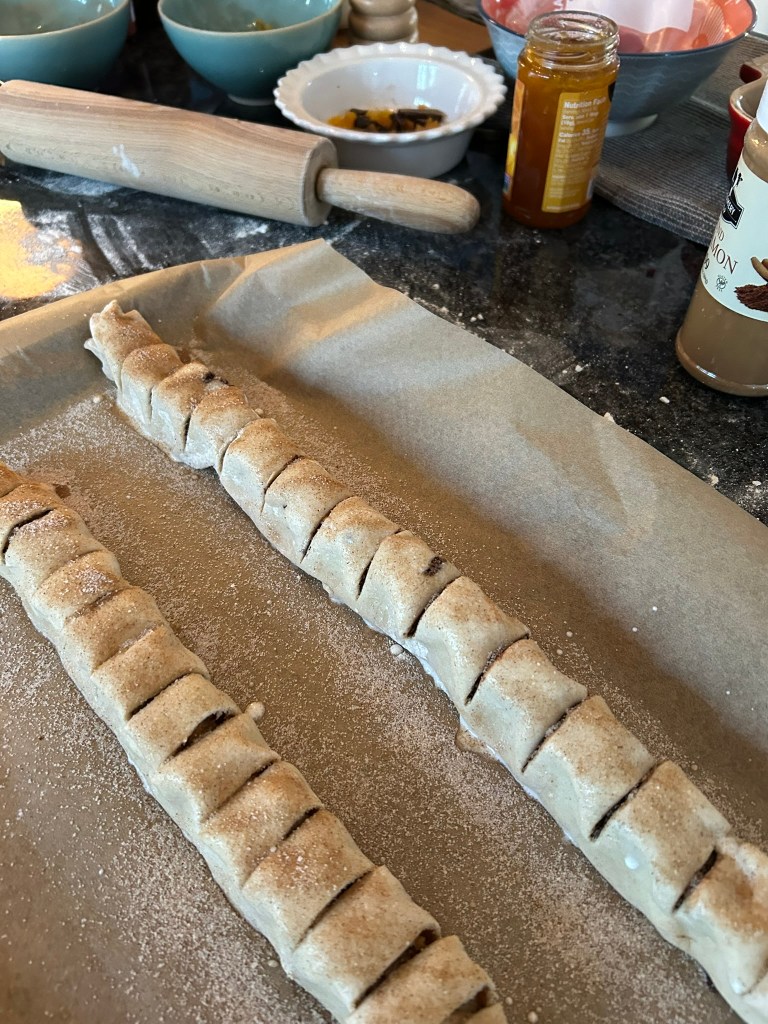
We planned a small Hanukah party and our daughter Lev, who is an excellent baker, offered to make rugelach. For those not familiar with this delicacy, the pastry can be traced back to medieval times in Eastern Europe within the Ashkenazi Jewish communities of Poland.
Various fillings of nuts, chocolate, apricot and raspberry jams are encased in a delicate cream cheese based pastry. Lev even made a sugar free version for my husband, using dried apricots and chopped Lily’s Stevia chocolate.
Apricot and Chocolate Rugelach (Recipe adapted from Epicurious.com)
Dough:
2 cups all-purpose flour
½ tsp. kosher salt
2 sticks (1 cup) unsalted butter, softened
8 oz. cream cheese, softened
Fillings:
½ cup plus 4 tsp. sugar
1 tsp. cinnamon
1 cup apricot preserves
1/2 cup toasted walnuts (or toasted pecans!)
1/2 cup finely chopped dried apricots (for sugar free version)
2 ounces bittersweet chocolate, melted with 1 tablespoon bitter, mixed with enough cinnamon sugar to make a paste similar to Nutella.
1/4 cup toasted walnuts, finely chopped. Pecans are also great!
Milk for brushing cookies
Special equipment: parchment paper; a small offset spatula
Preparation
Step 1:Whisk together flour and salt in a bowl. Beat together butter and cream cheese in a large bowl with an electric mixer until combined well. Add flour mixture and stir with a wooden spoon until a soft dough forms. Gather dough into a ball and wrap in plastic wrap, then flatten (in wrap) into a roughly 7×5″ rectangle. Chill until firm, 8 to 24 hours.
Step 2:Put oven rack in middle position and preheat oven to 350°F. Line bottom of 1–1½”-deep large shallow baking pan with parchment paper.
Step 3:Cut dough into 4 pieces. Chill 3 pieces, wrapped in plastic wrap, and roll out remaining piece into a 12×8″ rectangle on a well-floured surface with a floured rolling pin. Transfer dough to a sheet of parchment, then transfer to a tray and chill while rolling out remaining dough in same manner, transferring each to another sheet of parchment and stacking on tray.
Step 4:Whisk ½ cup sugar with cinnamon.
Step 5:Arrange 1 dough rectangle on work surface with a long side nearest you. For Apricot Rugelach: Spread ¼ cup preserves evenly over dough with offset spatula and a rounded ¼ cup walnuts over jam, then sprinkle with 2 Tbsp. cinnamon sugar. For Chocolate Rugelach, melt 2 ounces chocolate and mix with enough cinnamon sugar to make a coarse paste, similar to Nutella in texture. Spread evenly over dough and then sprinkle 1/4 cup chopped walnuts on top.
Step 6:Using parchment as an aid, roll up dough tightly into a log. Place, seam side down, in lined baking pan, then pinch ends closed and tuck underneath. Make 3 more logs in same manner and arrange 1″ apart in pan. Brush logs with milk and sprinkle each with 1 tsp. of remaining granulated sugar. With a sharp large knife, make ¾”-deep cuts crosswise in dough (not all the way through) at 1″ intervals. (If dough is too soft to cut, refrigerate until firmer, 20–30 minutes.)
Step 7:Bake until golden, 45 to 50 minutes. Cool to warm on baking sheet set atop wire rack, about 30 minutes, then transfer logs to a cutting board and slice cookies all the way through.
ENJOY!!
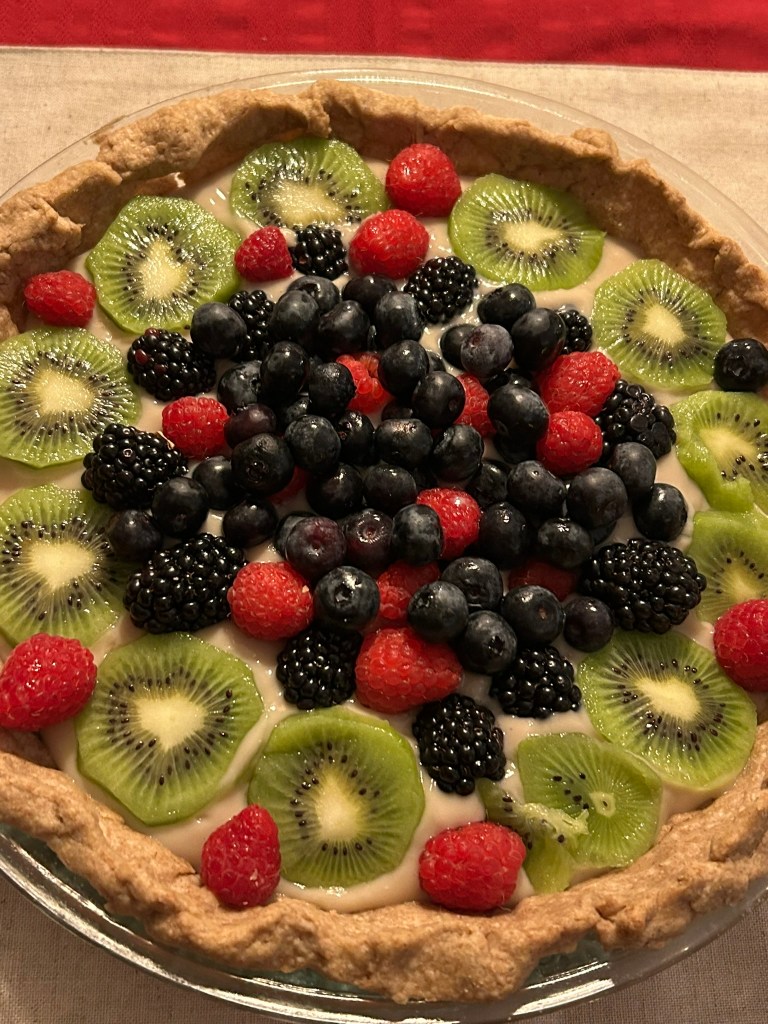
I created this fruit tart for my husband. There is only a small amount of coconut sugar (very low glycemic index) in the pastry filling and no sugar in the fruit. It is light and refreshing; totally guilt free!
Festive Fruit Tart
Pastry Filling:
1/2 cup cornstarch
1 1/2 cups unsweetened vanilla almond milk
2 tablespoons coconut sugar (more if sweeter taste is desired)
1 teaspoon vanilla extract
Pastry Crust:
1 cup whole wheat pastry flour
1 cup whole grain spelt four
1 teaspoon salt
1 stick unsalted butter
3 tablespoons non-hydrogenated shortening (I like the organic Spectrum brand)
3 or more tablespoons ice water
Fruit Topping:
1 large ripe kiwi- cut into think slices
1 /2 raspberries
1 cup blueberries
1/2 cup blackberries
Make the Pastry Filling:
In a small mixing bowl, whisk together cornstarch and 1/2 cup of the almond milk.
In a small sauce pan over low heat, bring the almond milk to a simmer with the coconut sugar.
Whisk in the remaining almond milk and stir constantly until the mixture thickens slightly. It will become much thicker after it cools.
Remove from heat and stir in vanilla. Refrigerate a few hours until very cold and the mixture has thickened. This can be made a day in advance.
Make the pastry crust:
In the bowl of a food processor combine flours, salt, butter and shortening until just combined.
Add the ice water and process until a ball shape forms. You may need to add more water a tablespoon at a time.
Refrigerate at least one hour.
Bring pastry dough to room temperature.
Preheat Oven to 350 Degrees Farenheit
On a floured surface, roll the dough out and place into a pie dish. Trim and crimp edges. The crust will be completely baked and cooled before filling.
Prick the crust all over lightly with a fork and line the crust with a large sheet of parchment paper. Add pie weights (I use old coffee beans) to crust and bake in oven about 10 minutes. Carefully remove parchment paper and pie weights; continue to bake crust until it is lightly browned all over. If the edges seem to be browning too quickly, cover the edges with a small amount of foil. The crust will bake aprox. 15-20 minutes more.
Cool completely and then add cold pastry filling. Decorate with fruit and serve!
A last Winter’s Solstice blog for 2024! Here are some of my favorite late afternoon pictures from our shortest days of the year. Many thanks to my loyal followers. Best Wishes for a Happy Holiday and a Healthy New Year!
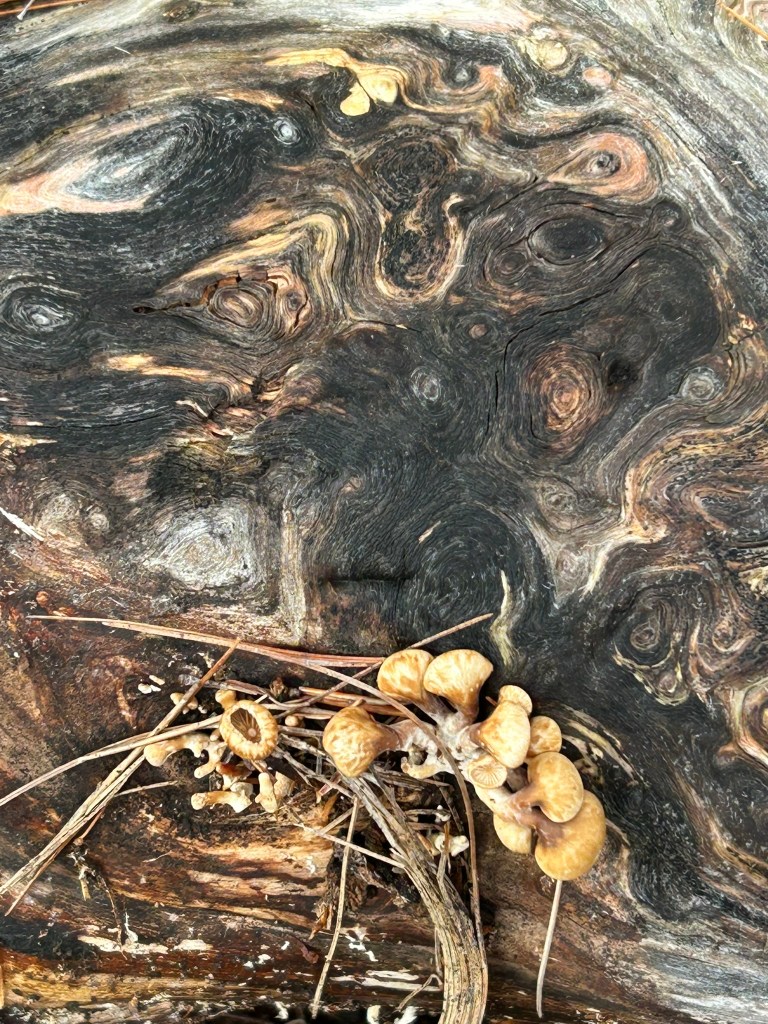
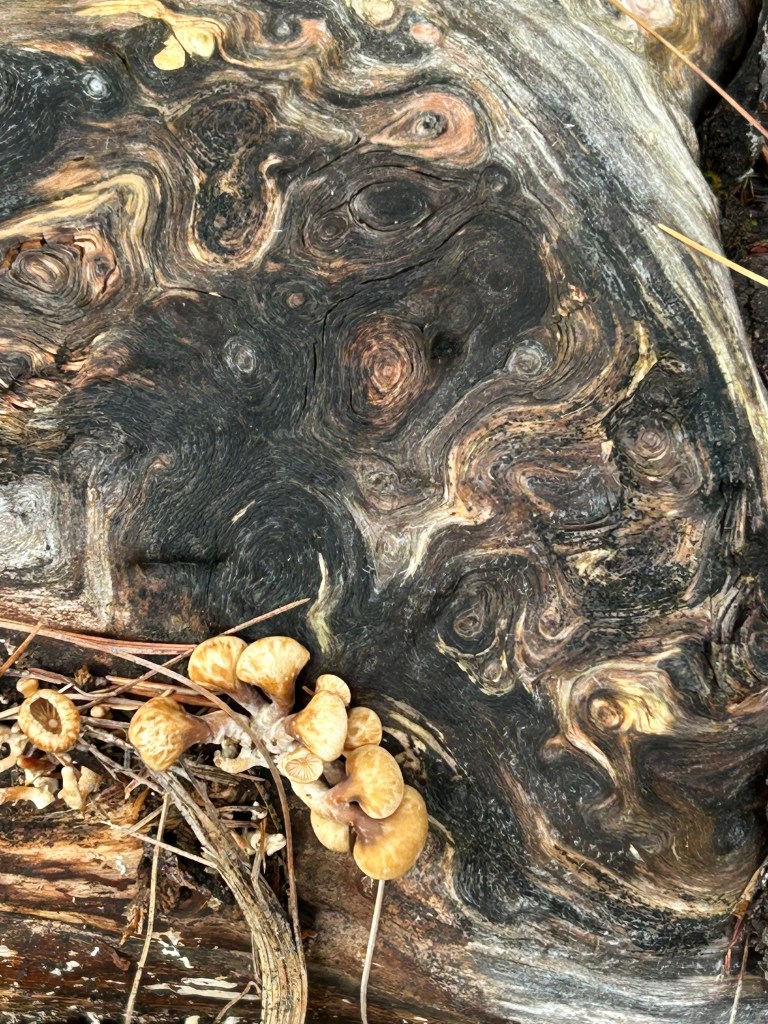
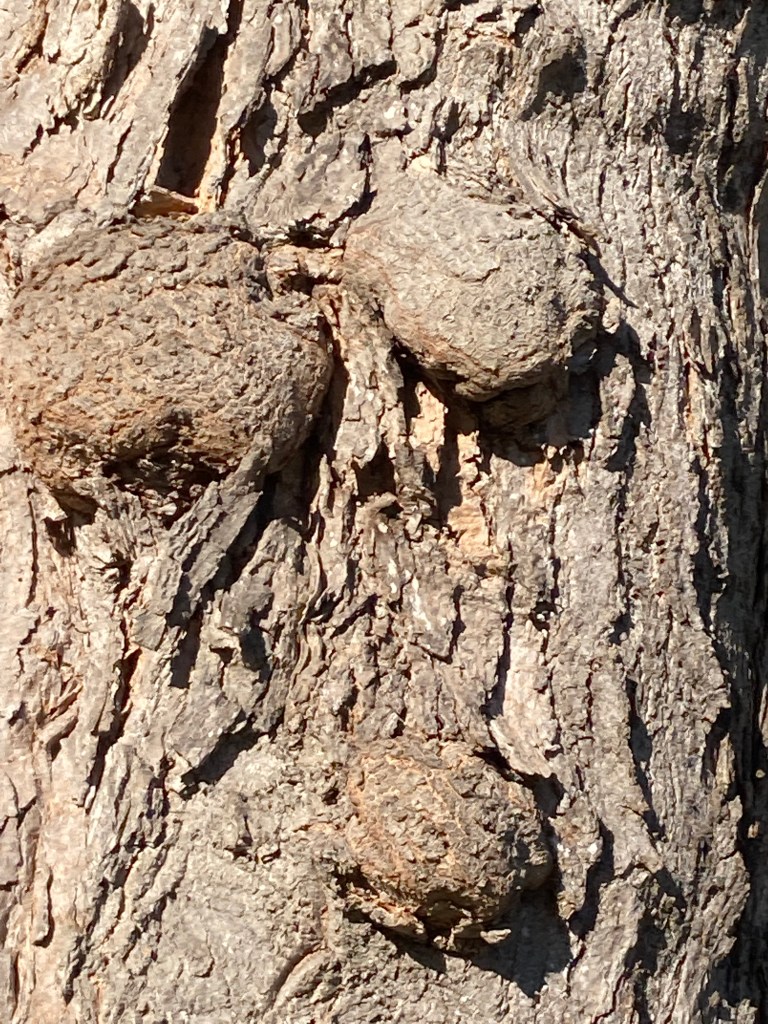
I can’t resist adding pictures with beautiful abstract patterns!
AND: Here’s a pic of our new house peeking through the woods!
STAY WARM AND COZY!
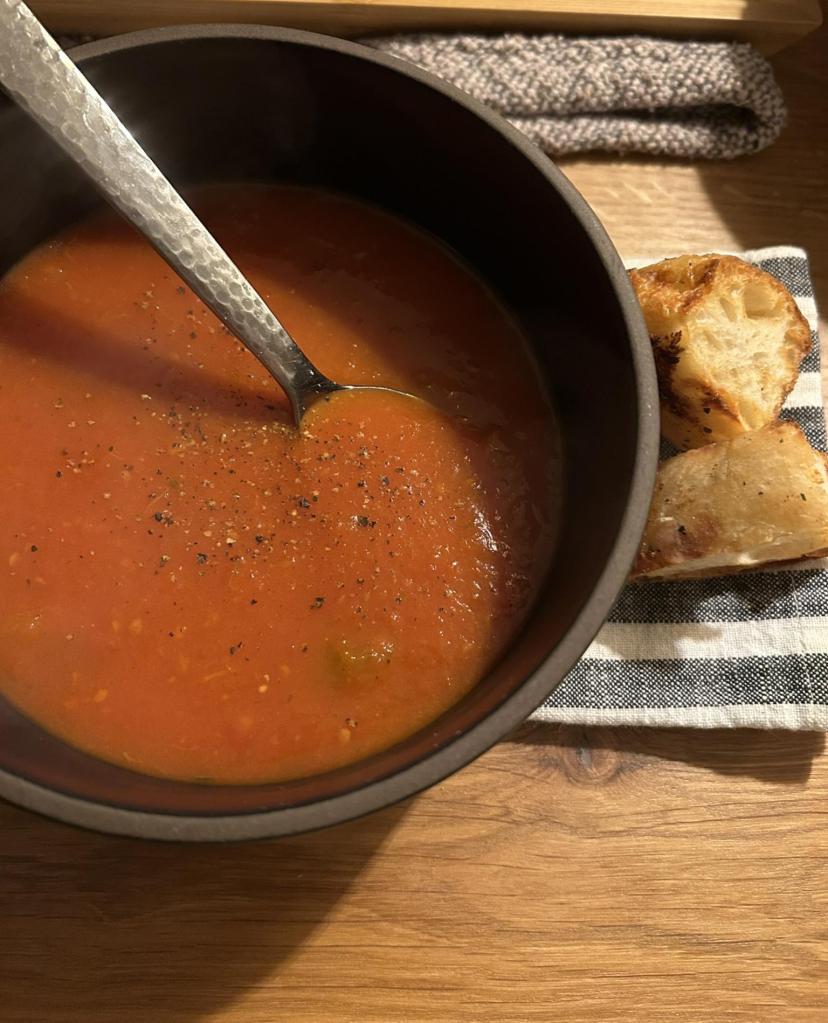
Here’s a recipe for Smoky Tomato Soup, that we had on a recent lunch at the newly reopened Roadside Diner in Monterey, Massachusetts. We enjoyed our version of soup with Crispy Sour Cream and Onion Chicken featured in my recent blog:https://wordpress.com/post/musicianstravels.com/9143 along with a green salad.
Smoky Tomato Soup
Ingredients:
2 large cans (28 ounce) whole plum tomatoes
1 small stalk celery finely chopped
1 medium onion finely chopped
1 small carrot finely chopped
2 teaspoons paprika
2 teaspoons smoked paprika
pinch cayenne pepper
1 teaspoon dried thyme
1 teaspoon ground cumin
1 bay leaf
salt and freshly ground pepper to taste
2 tablespoons extra virgin olive oil
1 cup water- more if needed
To make soup:
Heat olive oil in a large soup pot and add onions.
Saute onions until slightly softened. Add carrots and celery. A bit of chopped fennel might also be good! Cook a few minutes.
Add tomatoes and rest of ingredients.
Bring to a boil, reduce heat to a simmer. Cover and cook about 1 hour. Add more water if soup is too thick.
Remove Bay leaf and puree with an immersion blender. Remaining chunks of vegetables are fine.
It was the day after the election and the members of the Hevreh Ensemble were in a state of disbelief as we embarked on a short tour to Portland, Oregon. The plane headed west into the sunset; what better time for a little escape and to bring our music to others!
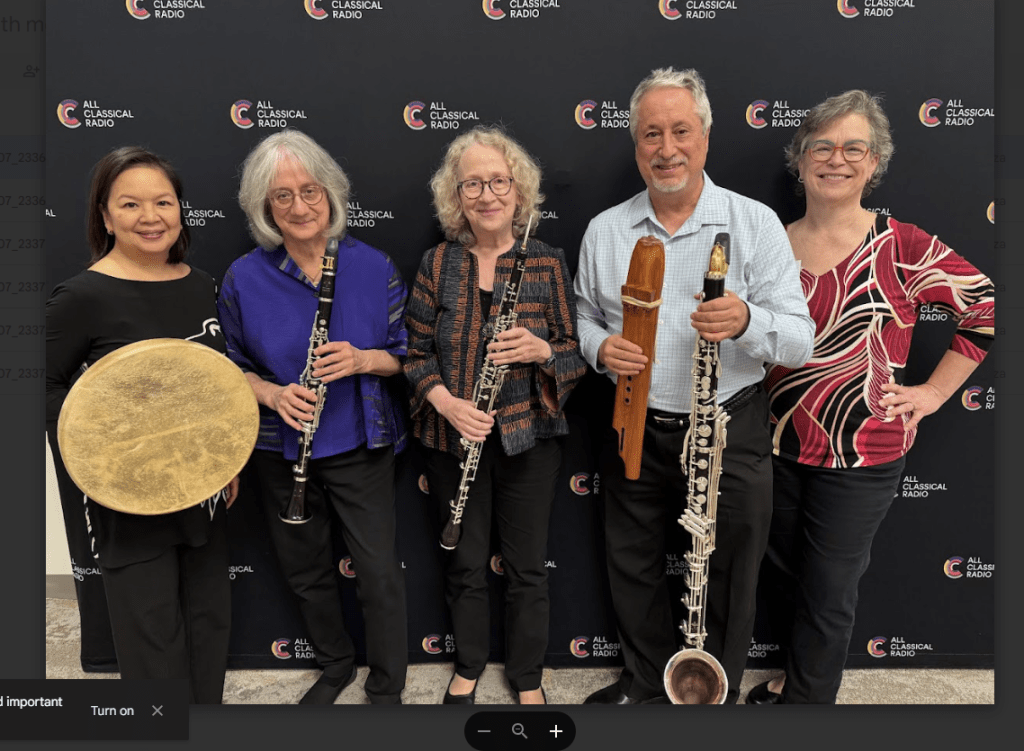
A week of concerts were planned with the first at one of my favorite radio stations, All Classical Portland. We were warmly welcomed by our host Christa Wessel and a lovely staff of helpful engineers.
I was especially excited because Portland has a growing reputation as a foodie city. A few weeks earlier, I had read an article in the New York Times; “The 25 Best New Restaurants in Portland“. We were able to make reservations at the Korean restaurant Han Oak and the award winning Thai restaurant Lang Baan.
I had done some research on the bakery scene in Portland; the other members of the Hevreh Ensemble know me well and were excellent participants in the planned food adventures!
There were many choices to write about, but a few standouts were the Korean restaurant Han Oak, the Orange & Blossom Bakery and the Portland FarmersMarket.
After our first concert for All Classical Portland, we headed off to an evening dinner at Han Oak. Our Uber driver dropped us off in a residential area and we almost missed the entrance; the eccentric and festively decorated restaurant was tucked away in the backyard of a small business.
The restaurant is owned by chef Peter Cho and his wife and partner, Sun Young Park; the food was creative and delicious. The current menu, with a $65 prix fixe was well worth the price! We started with 4 small appetizers that were replenished as often as we wanted throughout the meal.
They included homemade Napa cabbage and daikon kimchi made by the chef’s mother, pear and seasonal mustard greens with silken tofu miso dressing, fried eggplant with lemon ssam jabg (Korean soybean paste), garlic chives and scallions and smashed potato salad with eggs, garlic chives, celery, carrot and shredded gim (seaweed). Along with icy Korean beer, this could have been a complete meal!
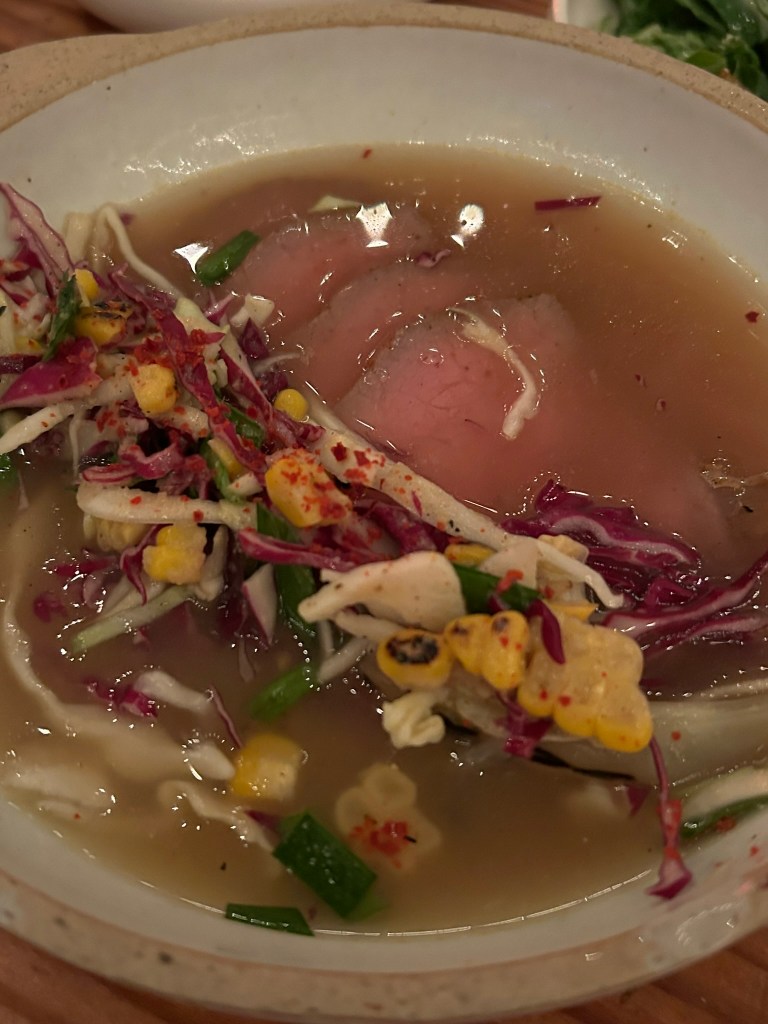
Our next course was Roast Beef Soo Yook- delicate and tender rare roast beef with seared green and purple cabbage and charred corn vinaigrette in a rich bone broth, simmered for 15 hours.
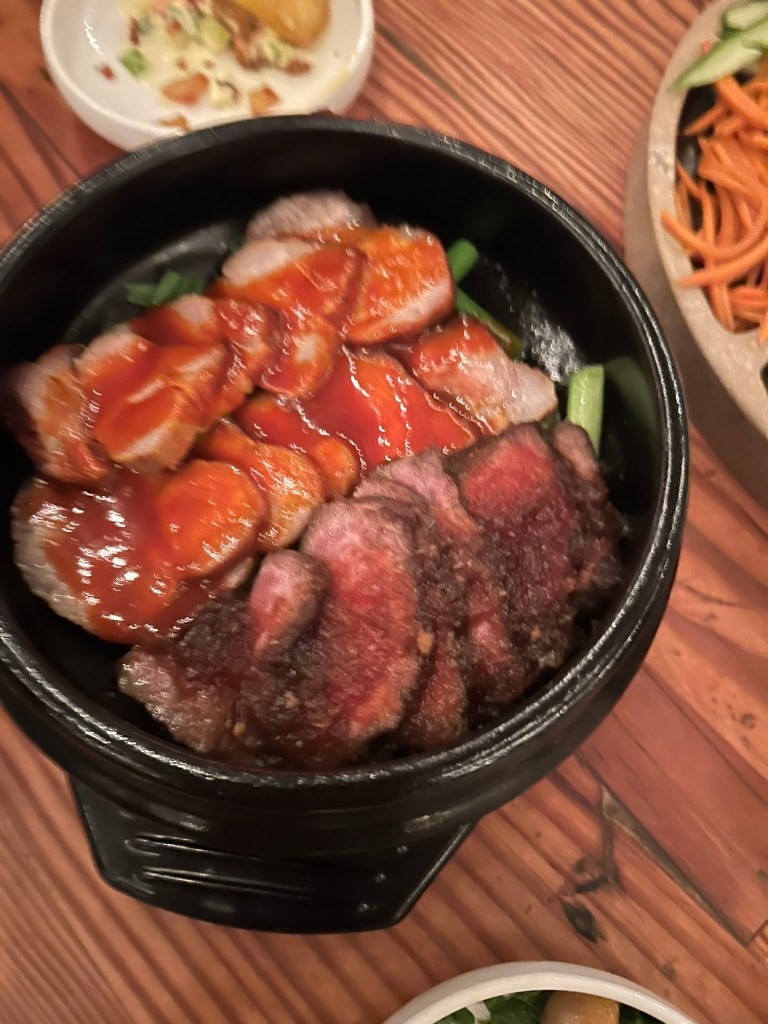
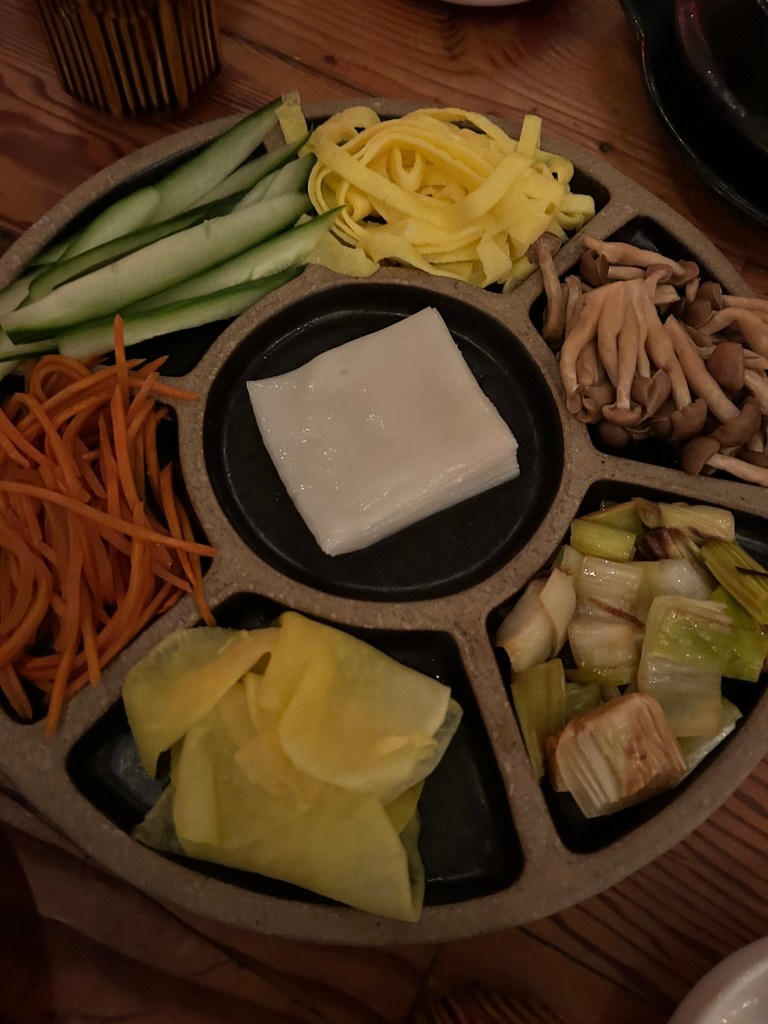
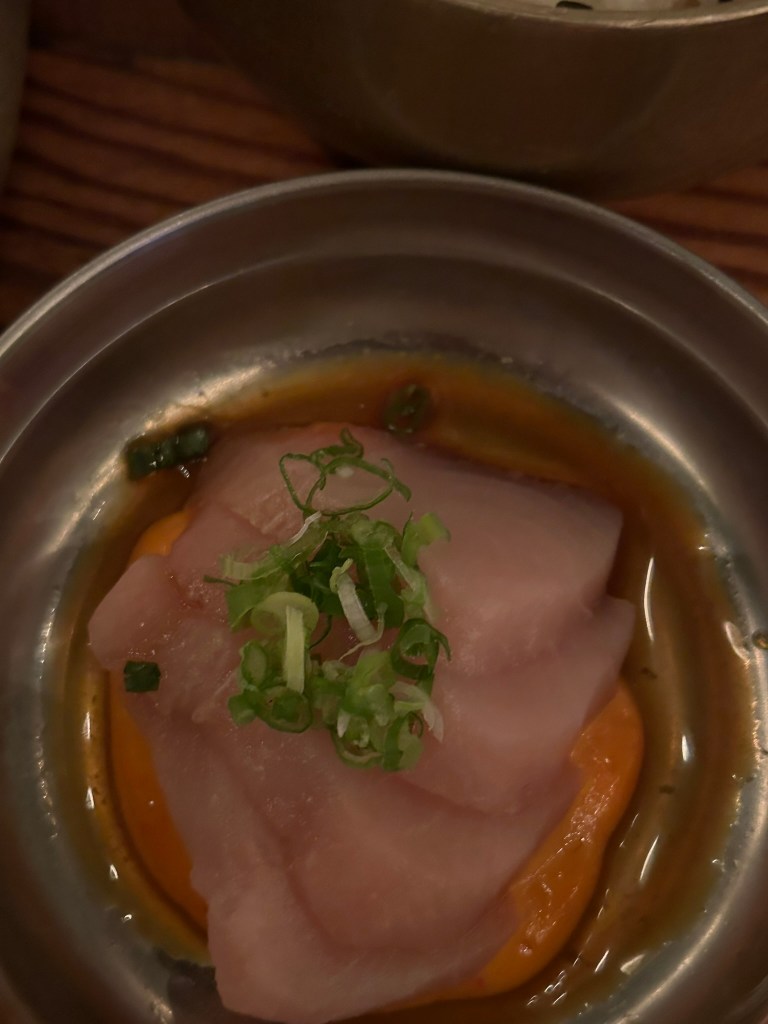
The next course was billed as a “Gimbap Party”. We were presented with platters of barbequed meats and vegetables along with seaweed, rice paper and seasoned rice. My favorite was a bowl of hamachi (a delicate Japanese fish that is often found in the Northwest) cured with citrus and yuzu soy and served over chojang-mayo (a spice Korean sauce) and scallions. We had great fun creating or own seaweed and rice rolls.
Himachi with citrus, gochu-mayo, yuzu soy and scallion
Surprisingly, after all of this food, we still had room for a delicious dessert that the table shared: caramelized custard poached pears with sweetened puffed rice, vanilla whip and misugaru sauce ( a Korean beverage made from a traditional grain powder). At this point, I jokingly told the group, that the real reason we had traveled to Portland was actually for the food!
Caramelized custard poached pears with sweetened puffed rice, vanilla whip and misugaru
The next day, group members Laurie and Jeff had to tend to repairs on a Bass Clarinet that had encountered an unfortunate fall after our concert for All Classical Portland.
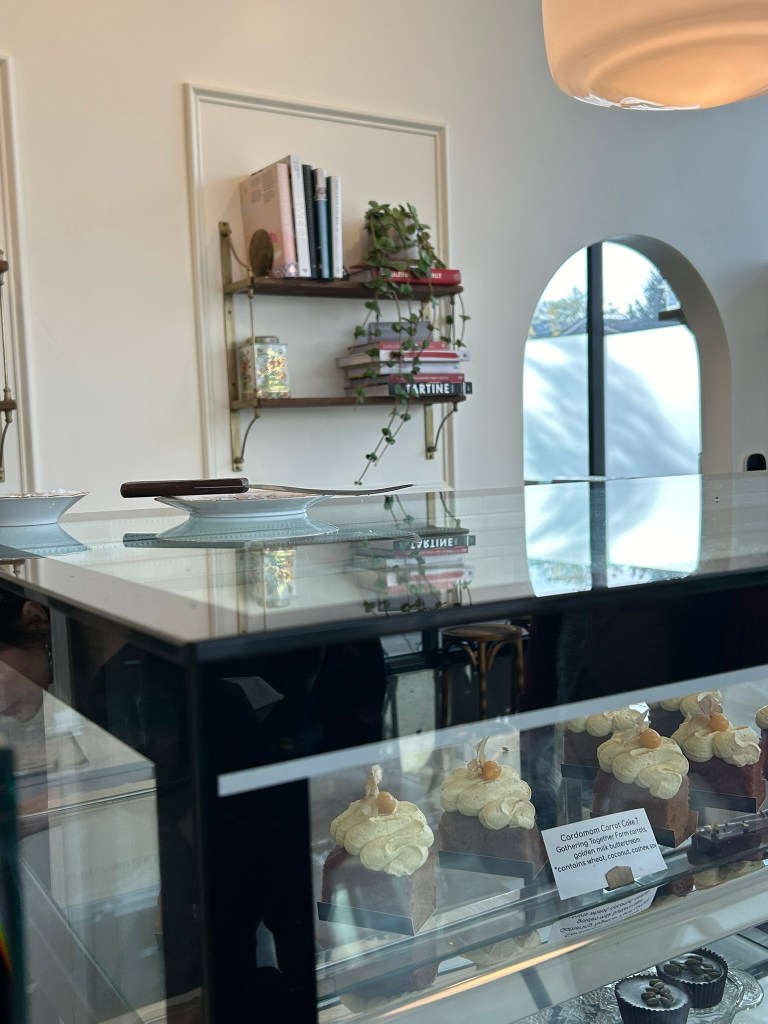
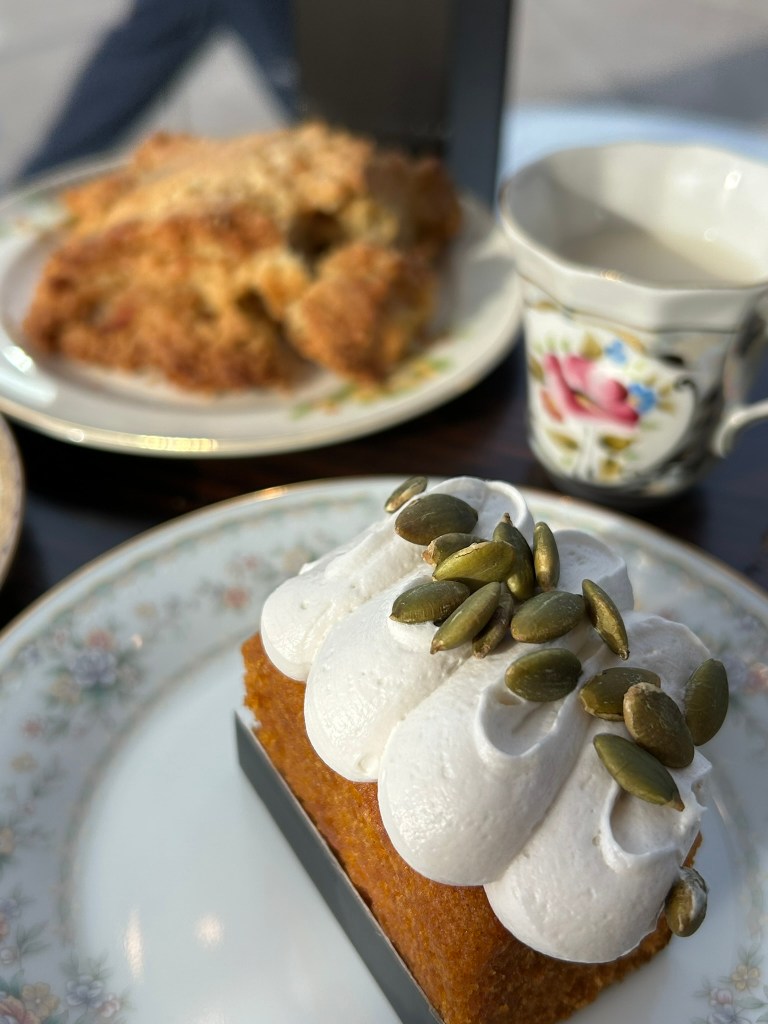
With a free afternoon before our evening concert, our guest keyboardist Renee and I headed out for a bakery adventure. I had read about an excellent bakery called Orange & Blossom. This turned out to a be a wise choice. The moment we entered the small cozy store, we were mesmerized by the wonderful assortment of beautifully presented baked goods.
The description on the bakery’s website says: “rooted in the seasons, inspired by our travels, local farms and west coast roots.” The cases were filled with enticing pastries that had an autumnal theme.
We ordered a pot of tea, a sandwich and assorted pastries for lunch. It was hard to choose but we ended up with a delicious sandwich with home made foccaccia that was filled with beet hummus, pickled vegetables, frisee and spread with garlic cashew cream cheese.
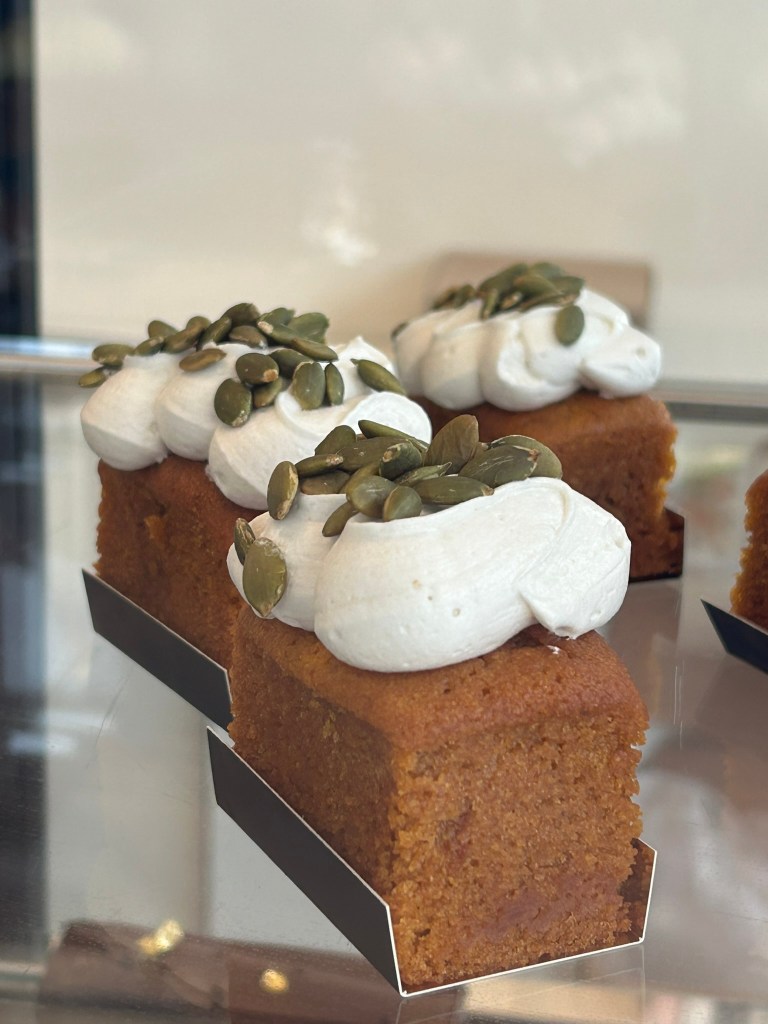
We shared a slice of pumpkin maple cake made with kabocha squash, maple butter cream and roasted peptitas, an unbelievably rich peanut cup filled with squash and peanut butter AND a rosemary orange scone.
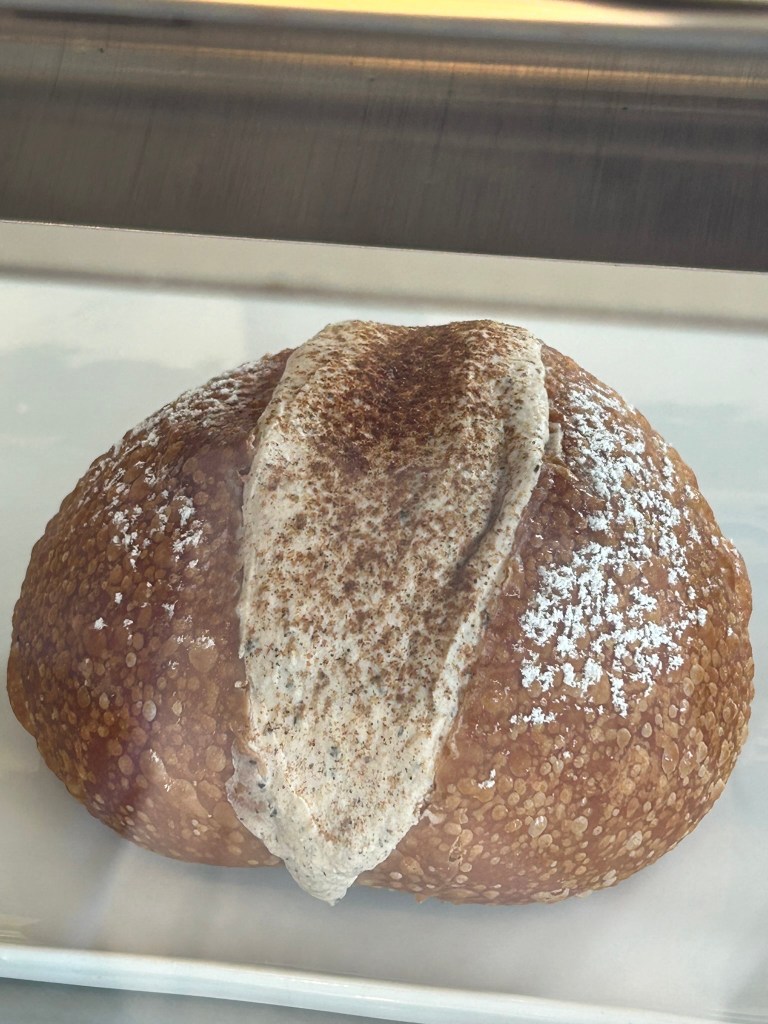
Thinking we had probably ordered too much, I am sorry to say that we did not try the pear chai Manitozzi (Rome’s most iconic brioche bun).
Pear chai Manitozzi
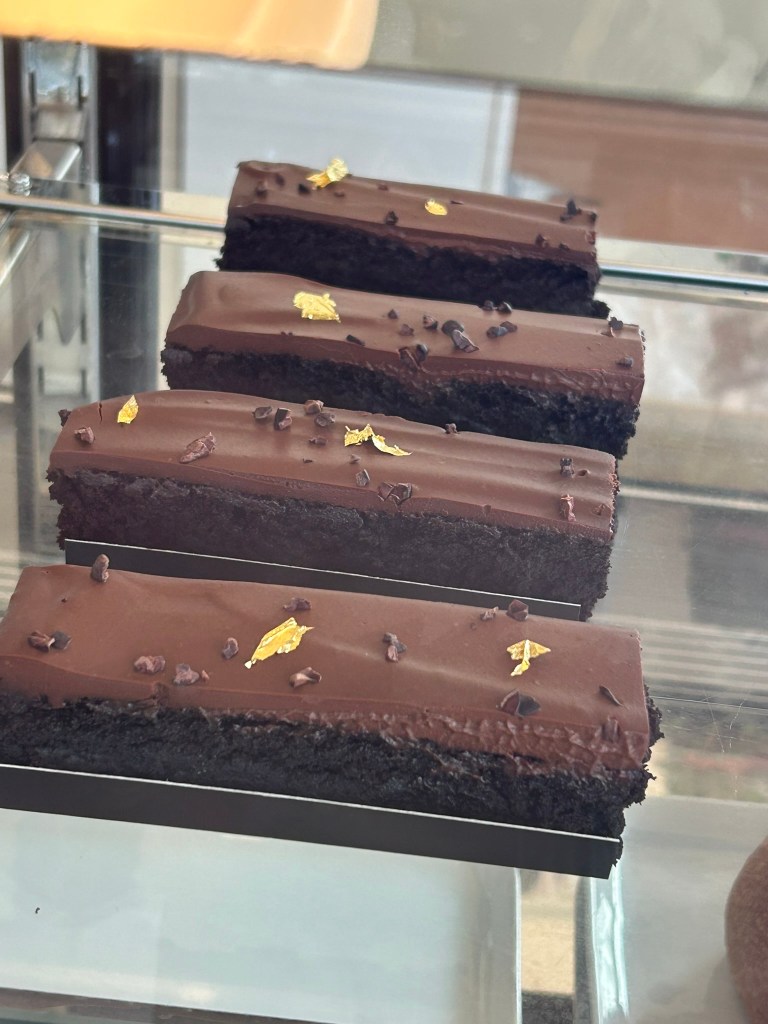
We did buy an unusual and incredible brownie made with milled buckwheat, dark chocolate ganache and cocoa nibs for the airplane ride home!
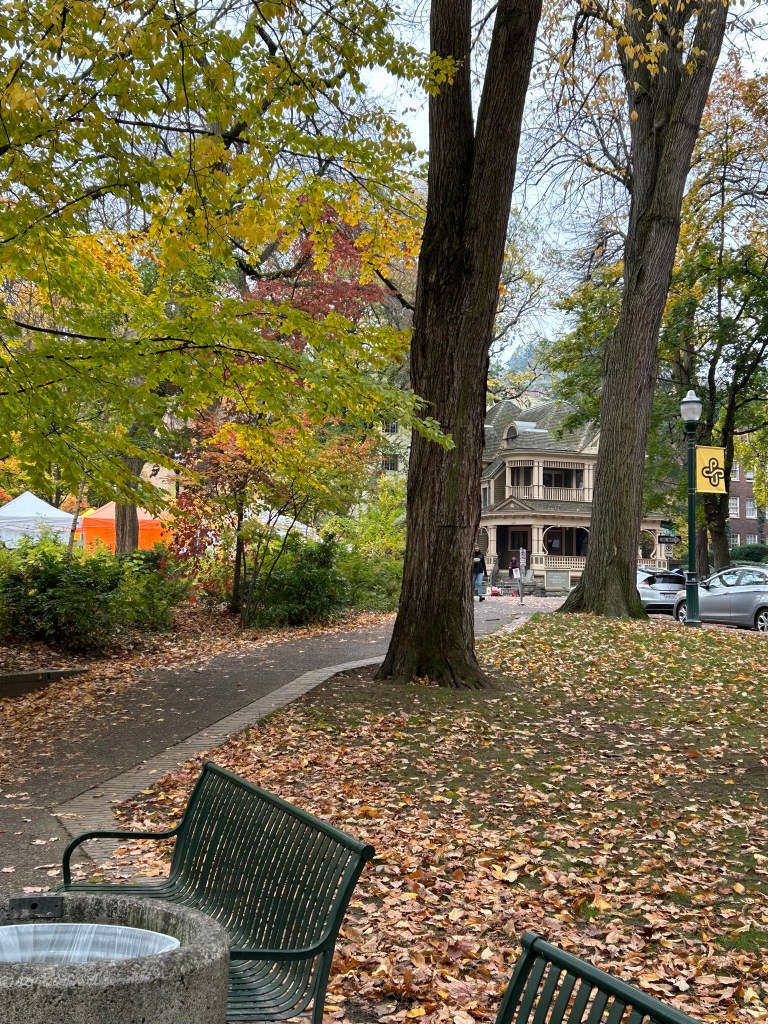
On Saturday, we had a free day with an evening concert at the Jewish Museum and Center for Holocaust Education. I am so glad that we had the chance to visit the famous Portland Farmers Market. After a long walk from our hotel, we finally saw the colorful booths poking through the trees located at Portland State University.
There were countless stands of beautiful organic fruits and vegetables along with stands ranging from cheeses, organic meat and seafood along with artisanal breads and pastries.
Street musicians played at various locations throughout the market.
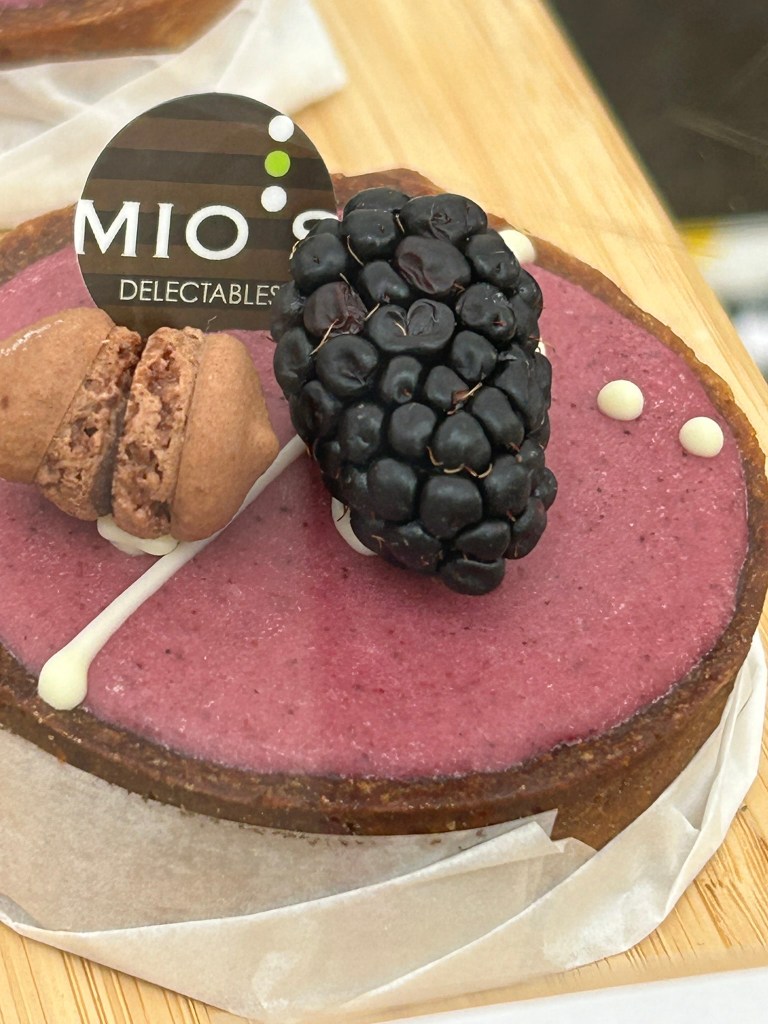
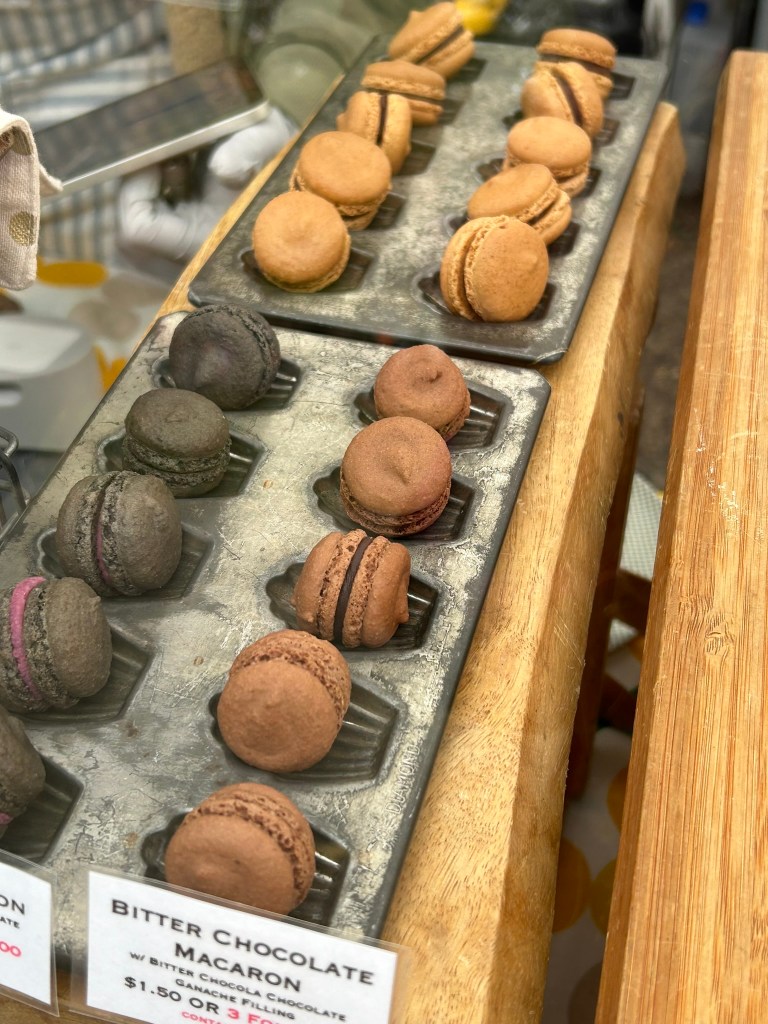
I strolled by stand after stand of beautiful pastries; I bought a tiny bittersweet chocolate macaron. Popping it into my mouth, it was full of flavor-perfect!
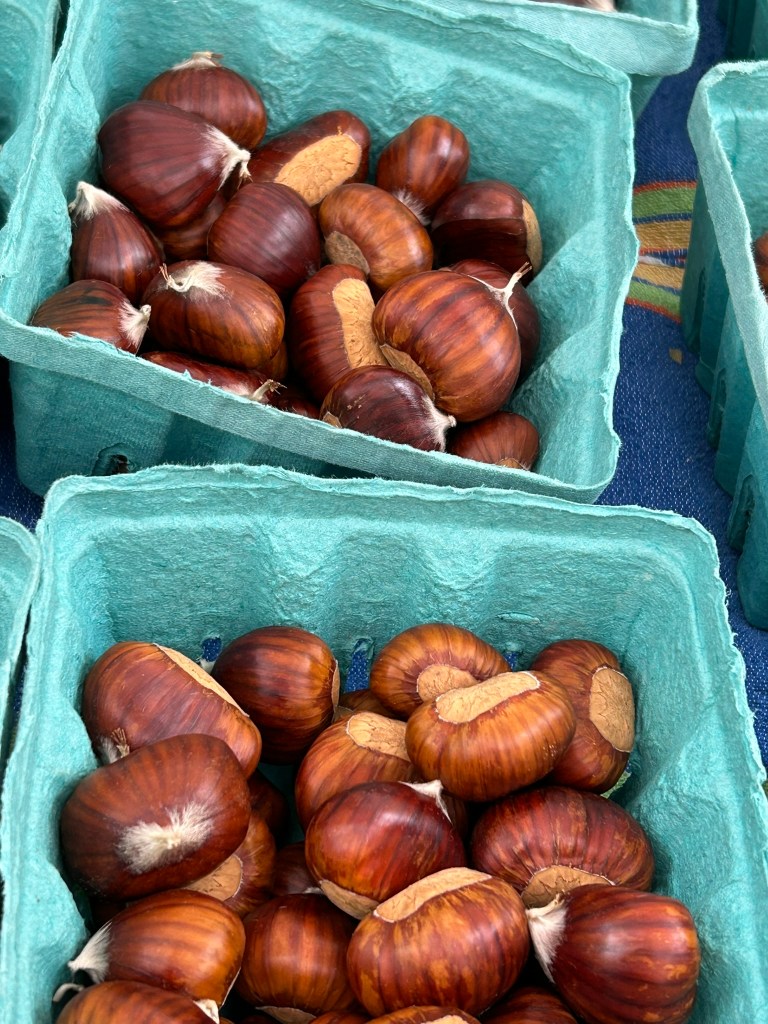
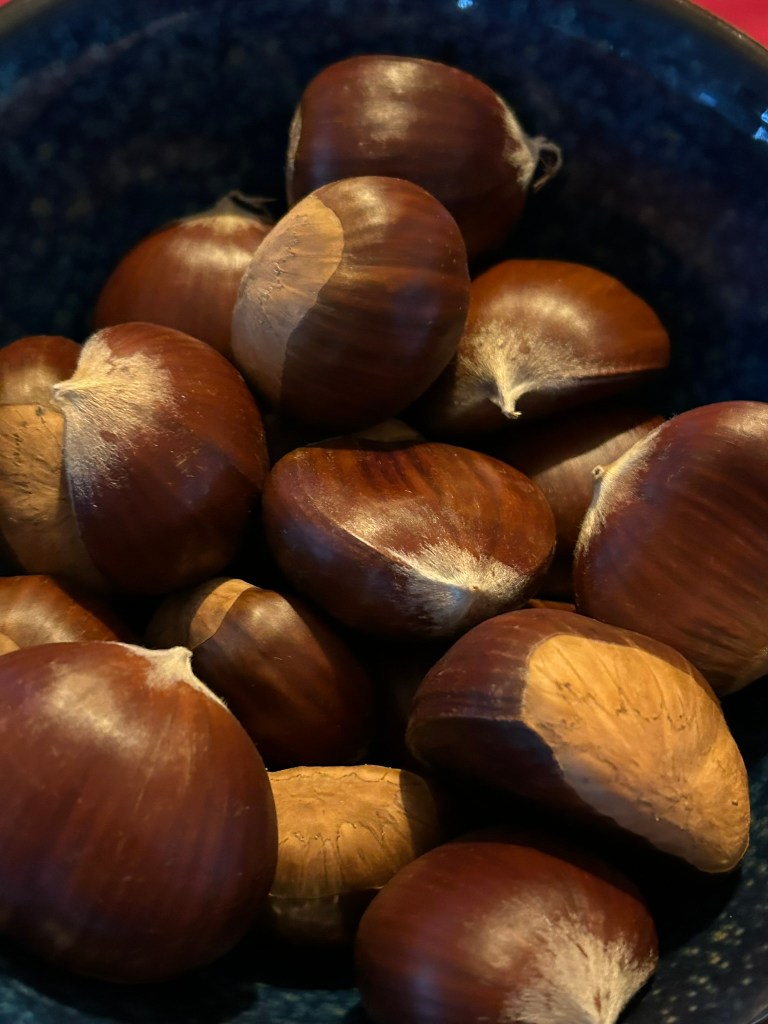
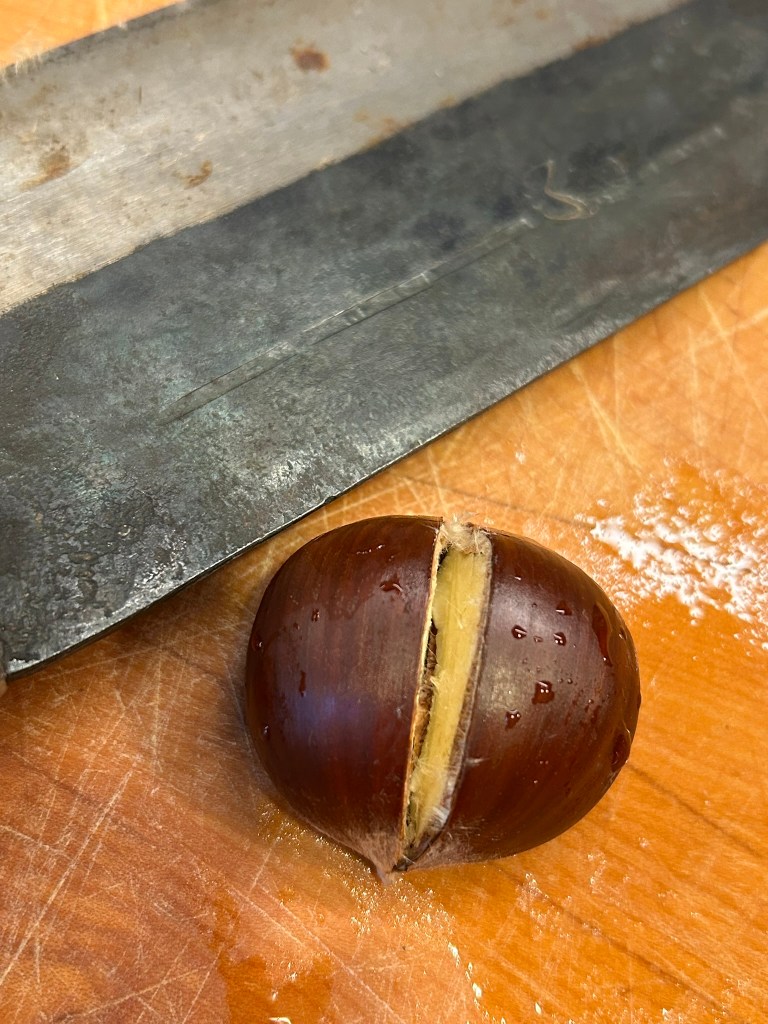
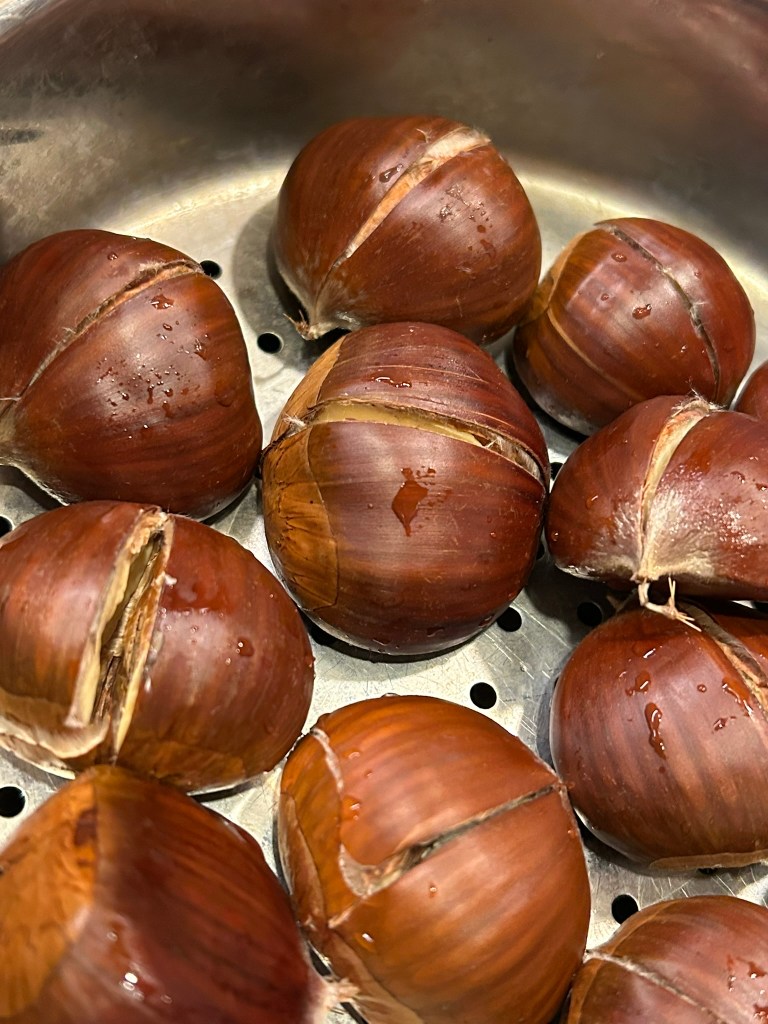
I passed by a stand of fresh chestnuts and could not resist buying a quart. The owner of the stand was very engaging and described a fool proof method to peel the shells easily. He said to cut almost all of the way through the shell with a heavy cleaver and then steam the chestnuts about 10 minutes.
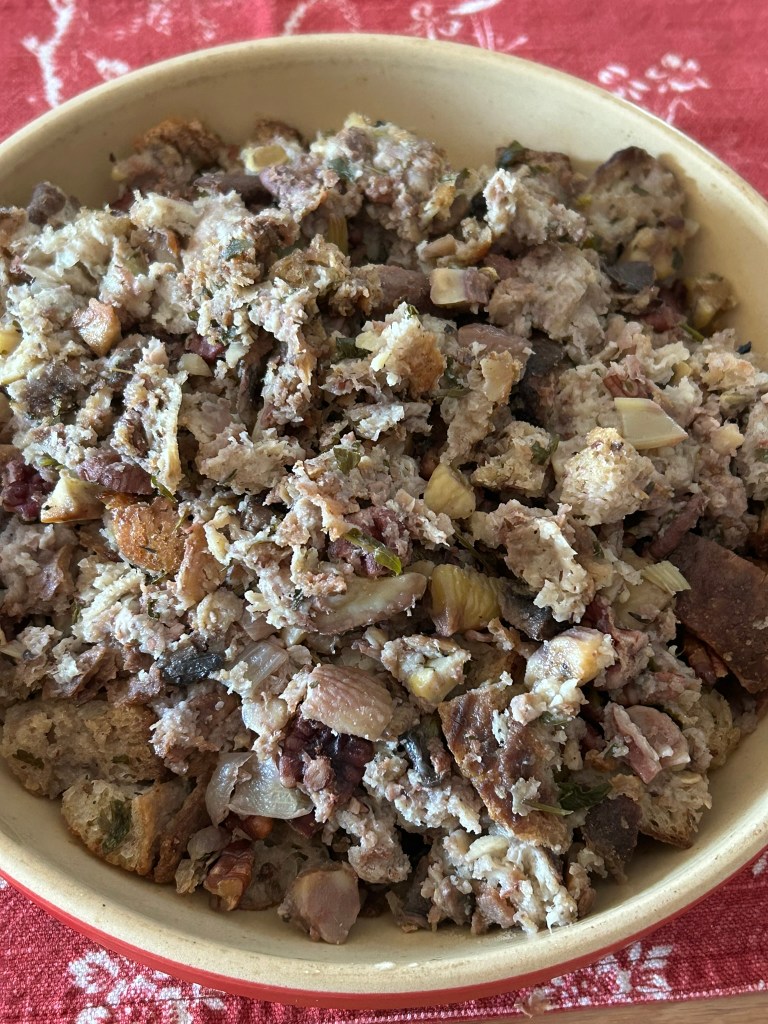
I took my chestnuts that I purchased at the farmers market home. Tucked away safely in my suitcase, I was looking forward to making our Thanksgiving turkey with a sour dough stuffing that included braised chestnuts.
Our last concert at the Jewish Museum and Center for Holocaust Education was in commemoration for the anniversary of Kristalnacht (Night of Breaking Glass) that occurred in Germany in November 1938 in a wave of antisemitic violence that swept through the country. The concert was a profound moving experience for all.
On the flight home, while the other passengers were eating their allotment of a tiny bag of peanuts, we broke out our chocolate ganache buckwheat brownie.
The rich nutty flavor of the buckwheat blended beautifully with the fudgy chocolate texture of the brownie. The end of a lovely trip!
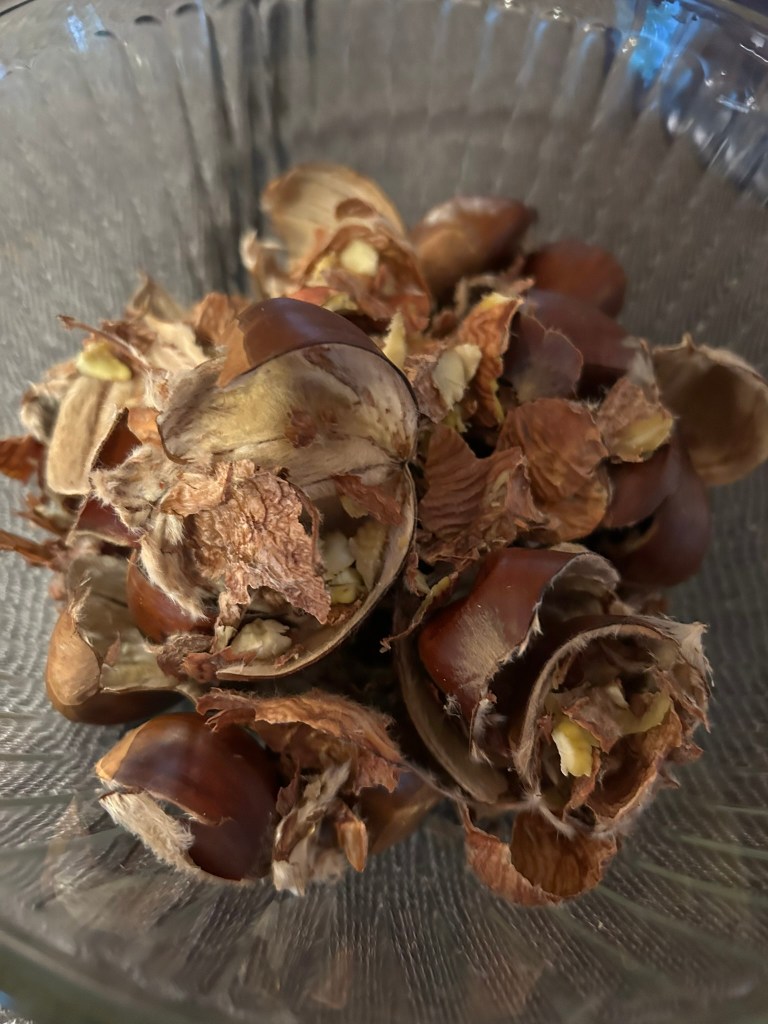
For Thanksgiving this year, I made sour dough stuffing with braised chestnuts. I prepared the chestnuts using the method the person at the farm stand recommended and it worked like a breeze! For a few recalcitrant chestnuts, I steamed them for about 3-4 minutes more and the shells and skins slipped easily off!
AND, there were lovely scraps for all of the critters in our woods!
I tasted a braised chestnut and it was sweet, tender and earthy- they made a delicious stuffing that would also be good for a Christmas roast goose or chicken!
ENJOY!!
Sour Dough Stuffing with Braised Chestnuts, Mushrooms and Pecans
Ingredients:
Large bowl of dried sourdough bread cubes (from about 2 loaves of bread)
1 medium onion finely chopped
3 celery stalks with leaves finely chopped
6-8 button mushrooms chopped
2 teaspoons dried thyme (more if desired)
1 teaspoon dried sage (more if desired)
salt and freshly ground pepper to taste
braised chestnut mixture
1 cup toasted pecans broken into small pieces
2 cups chicken stock (more if needed)
2 tablespoons extra virgin olive oil
Ingredients Braised Chestnuts:
10-15 chestnuts peeled
1 large shallot finely diced
2 tablespoons butter
1 cup chicken stock
1 teaspoon dried thyme
freshly ground pepper to taste
To Make Stuffing:
Braise Chestnuts:
Melt butter in a small saucepan.
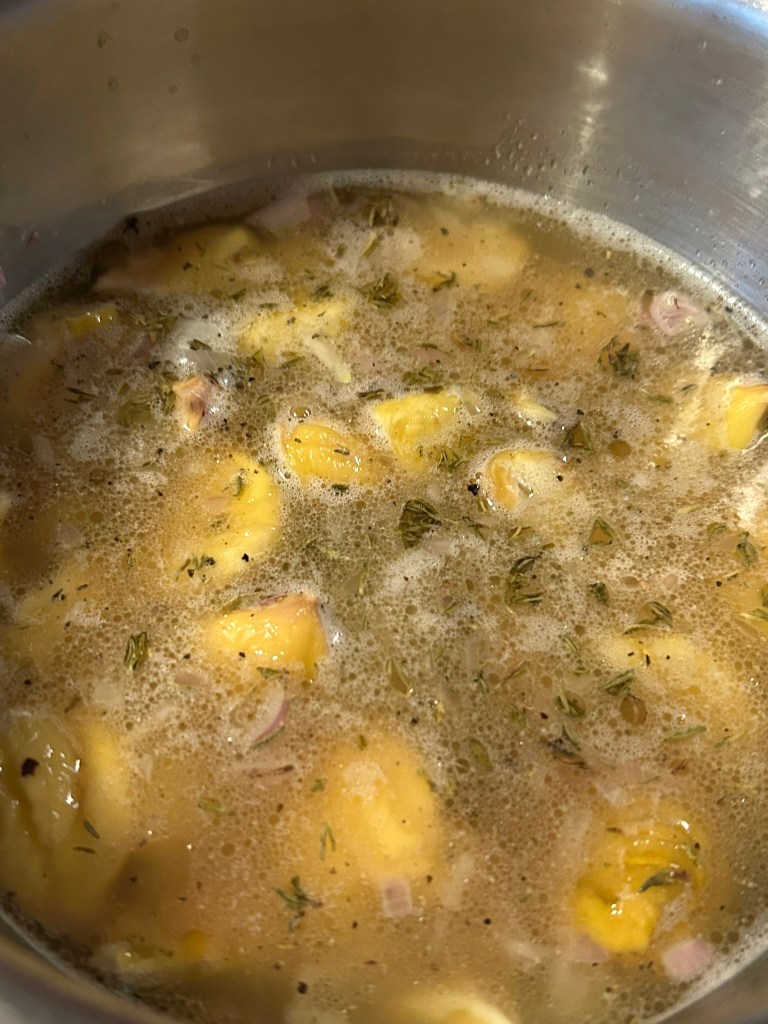
Saute shallots until softened, add chestnuts and cover with chicken stock.
Add dried thyme and freshly ground pepper.
Bring to a boil, reduce heat to a simmer, cover and cook for about 10-15 minutes.
Set aside while you prepare the rest of the stuffing. (Can be refrigerated for up to 2 days).
Prepare Stuffing:
Ina large saucepan, heat olive oil and added chopped onions. Cook until softened. Add celery and mushrooms. Cook until softened and mushrooms release their liquid.
Add dried thyme and sage and freshly ground pepper. Wait to add salt until stuffing is prepared.
Place the bread cubes in a large bowl and add the onion and braised chestnut mixture. Stir and add 1/2 cup of the chicken stock. It will take a while for the bread to absorb the liquid. Let mixture sit for a few minutes and gradually add rest of stock. You can always add more if needed. The mixture should be slightly softened. You should be able to squeeze clumps with your hands when ready to bake.
Let cool completely before stuffing turkey. After stuffing turkey, place rest of stuffing in a baking dish, cover and bake at 350 degrees about 35 minutes, remove cover and bake about 10 minutes more to create a delicious crusty topping and corners!
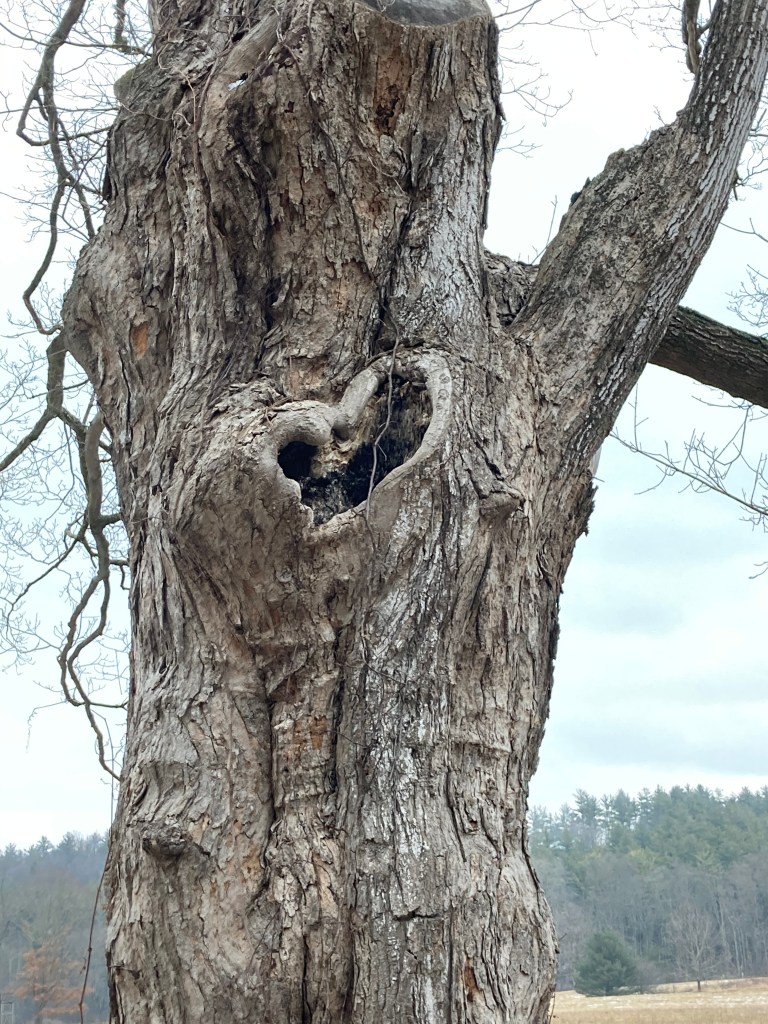
AND: Here is the “TREE OF THE WEEK” from Portland, Oregon!
Early Fall at the end of September- with noticeably shorter days; enough daylight to take a late afternoon walk at bucolic Twin Lakes.
I walked down the dirt road that curves around the lake, the contrast of the water and clouds is peaceful and calming; helping to put the events of the day and our turbulent world into perspective. Lately I have been thinking about how to stay involved and help in ways that can effect positive change; at the same time balancing the importance of self care- which today is the winner!
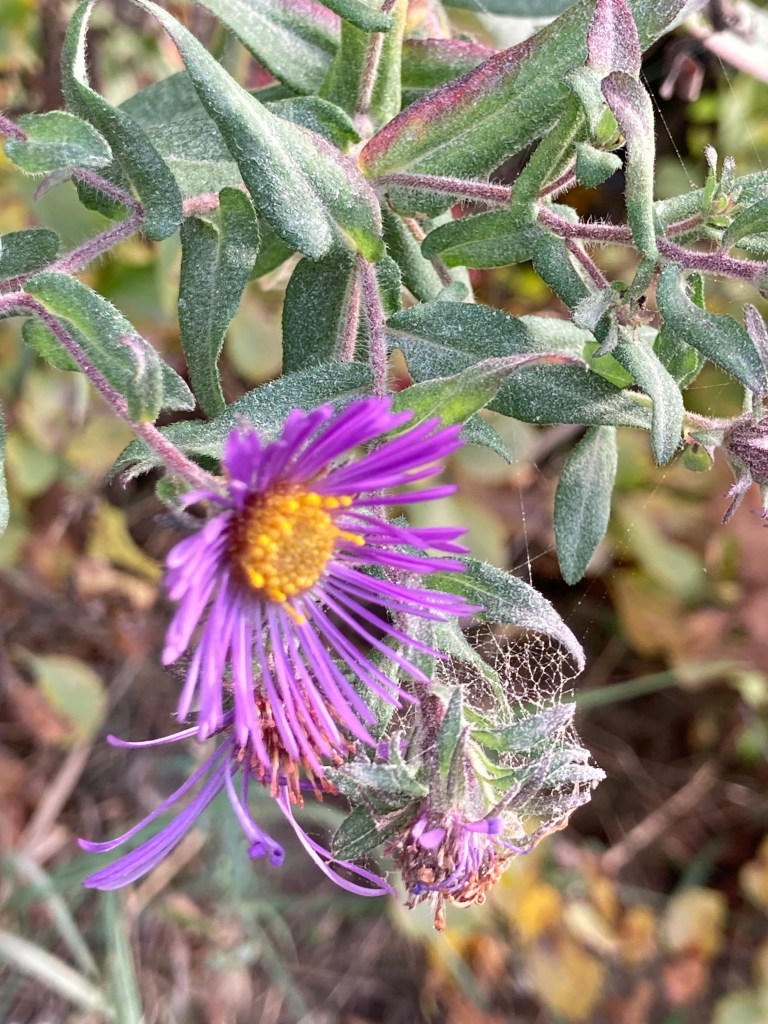
The leaves were just starting to turn and a few brilliant red leaves and a purple aster were suspended in lacey webs.
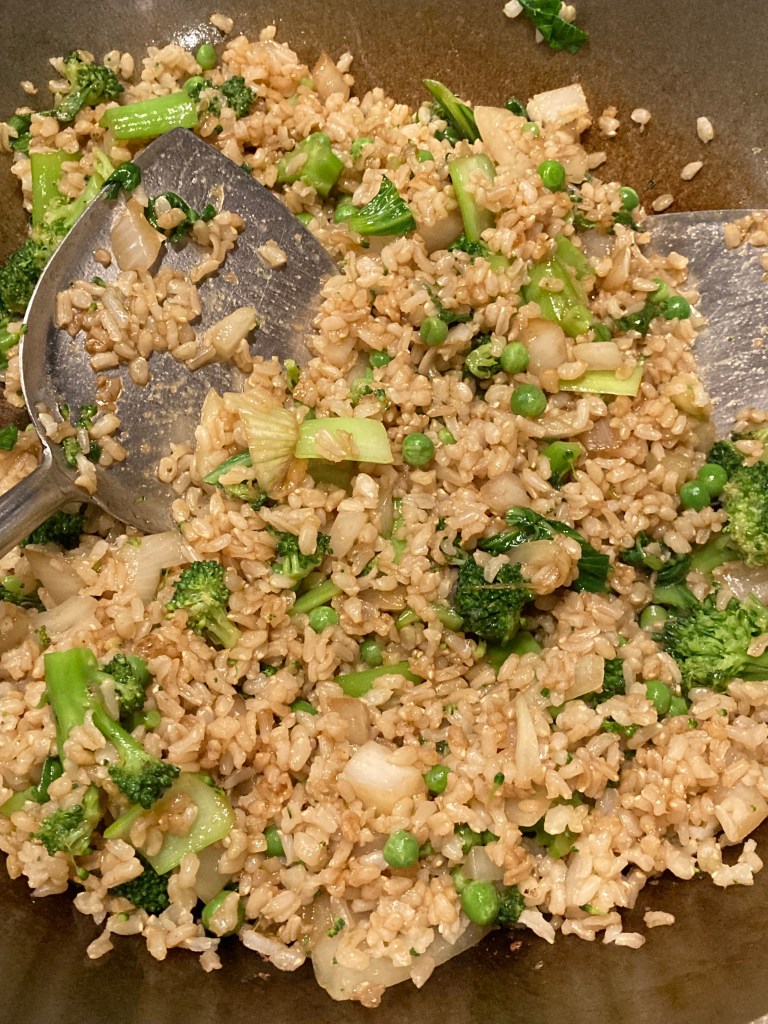
For dinner that evening, I was thinking of a way to use the leftover brown rice and vegetables that I had on hand. This would be a good time to take out my new wok to make a quick fried rice, which I got last spring in New York’s Chinatown at the venerable store, Hung Chong Imports.
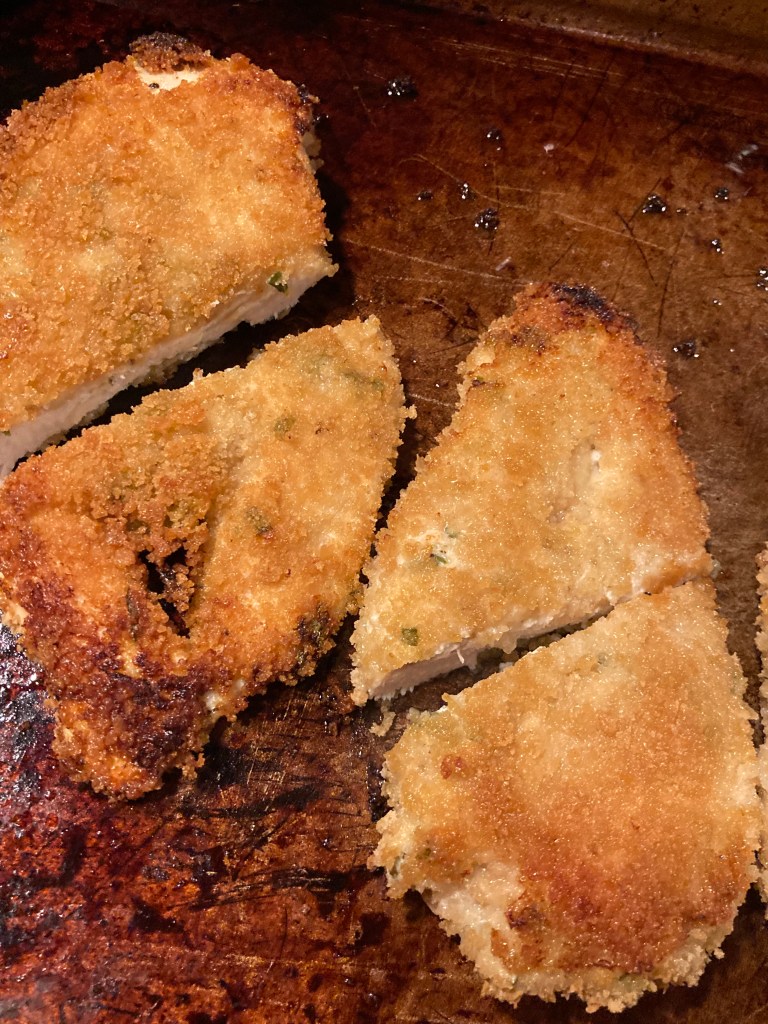
I had chicken breasts marinating in a mixture of yogurt, minced chives and onion powder (a strange combination, based on a NY Times Cooking recipe for Crispy Sour Cream and Onion Chicken). The yogurt tenderizes the chicken and the flavor does taste a bit like sour cream and onion dip! Coated in panko crumbs, drizzled with olive oil and baked in a hot oven results in the best crispy, tender and flavorful chicken! I just watched Yotam Ottolenghi, the Israeli and British chef, on a Stephen Colbert segment demonstrate his yogurt marinated chicken with North African spices. This is from his new cookbook, Comfort. I plan to try this version soon!
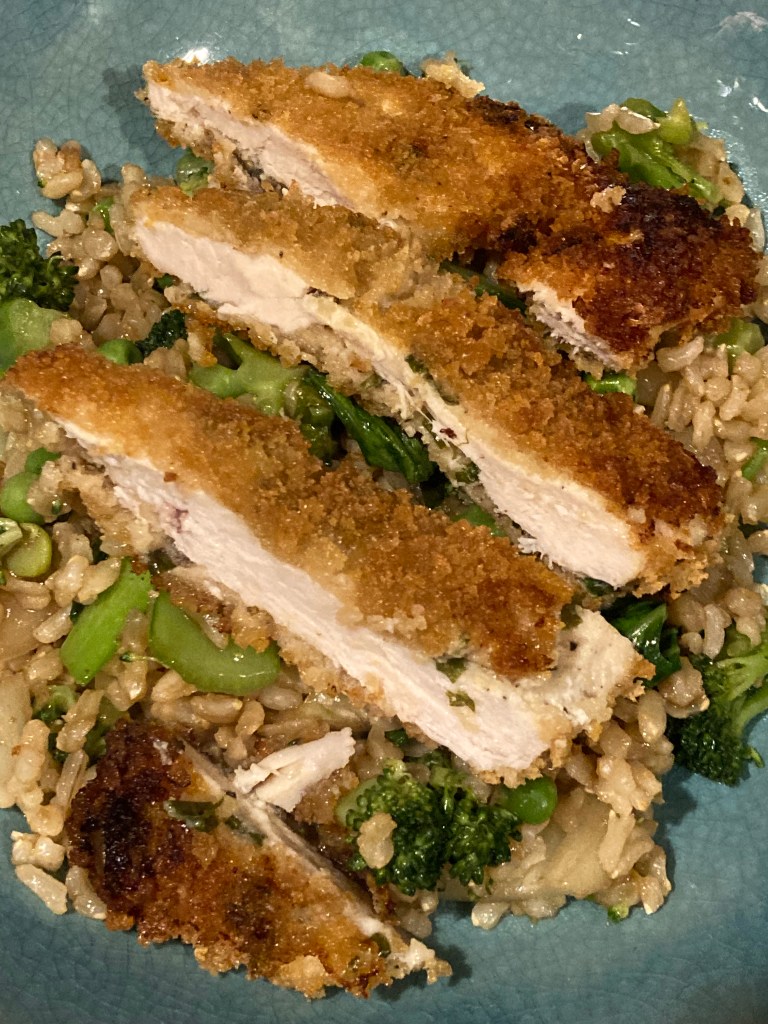
Sliced into thin strips and served over the fried rice, this turned into a delicious dinner!
Crispy Chicken Katsu with Fried Brown Rice
Fried Brown Rice Ingredients:
3 cups cold cooked brown rice
2 scallions finely chopped
1 small piece ginger, peeled and finely chopped
Assortment of vegetables (whatever you have on hand is fine)
2 stalks baby bok choy cut into small pieces
1 small onion finely diced
1/2 cup steamed broccoli (cooked briefly and rinsed in very cold water)
1/2 cup frozen peas defrosted
2 tablespoons canola or peanut oil
In a small cup mix together: 1/4 cup reduced sodium tamari, 1 tablespoon sesame oil and 2 tablespoons brown rice vinegar. For a spicier flavor, you can also add a small amount of hot chili sesame oil.
Chicken Katsu- (adapted from NY Times Cooking)
Ingredients:
4boneless, skinless chicken breasts, halved horizontally (see Tip) and pounded ⅛-inch thick, or use 4 chicken cutlets (don’t split or pound)
Salt and black pepper
½cup sour cream or Greek yogurt
¼cup thinly sliced chives (or 1 tablespoon dried chives), plus more for serving
2tablespoons onion powder
2cups panko bread crumbs
2 table spoons extra virgin olive oil
To make Chicken Katsu:
Preheat oven to 380 degrees and place rack on bottom of oven
Pat chicken dry, and season both sides with salt and pepper.
In a medium bowl, stir together the sour cream, chives and 1 tablespoon onion powder. Season with salt and pepper. Add the chicken and turn to coat. (Chicken can sit in the marinade for up to 8 hours. Refrigerate, then let come to room temperature before cooking.)
In a shallow bowl or lipped plate, stir together the panko and remaining 1 tablespoon onion powder; season with salt and pepper.
Working one at a time, press the chicken breasts into the panko, using your fingers to pack the panko onto both sides of the chicken, and place on a large sheet pan drizzled with olive oil.
Drizzle top of chicken with remaining olive oil and place in hot oven. Cook about 6 minutes until browned on bottom and then flip over. Continue cooking until chicken is cooked through and crispy and browned all over, about 6 minutes more.
Let sit for a few minutes and slice into small strips.
Note: With this recipe, you will have extra leftover chicken for sandwiches, etc.!
To Make Fried Rice:
TURN ON EXHAUST FAN OVER STOVE!!
Heat wok over high heat until it starts to smoke slightly. This helps to create the traditional Chinese cooking effect of “Wok Hei” translated as “breath of a wok” that gives the food the smoky charred taste found in Chinese dishes.
Add canola or peanut oil to the wok and heat until the wok starts to smoke slightly.
Add chopped scallions and ginger- give it a quick stir.
Add chopped onion and stirring continually, cook about 1-2 minutes until onion starts to soften a bit.
Add vegetables and cook, stirring continually about 2 minutes.
Add rice, cook about 1 minute, stirring and then pour the tamari mixture around the edges of the pan. This is the best part- the sauce will bubble vigorously and give off a wonderful aroma! Stir briskly and you are done!!
ENJOY!!
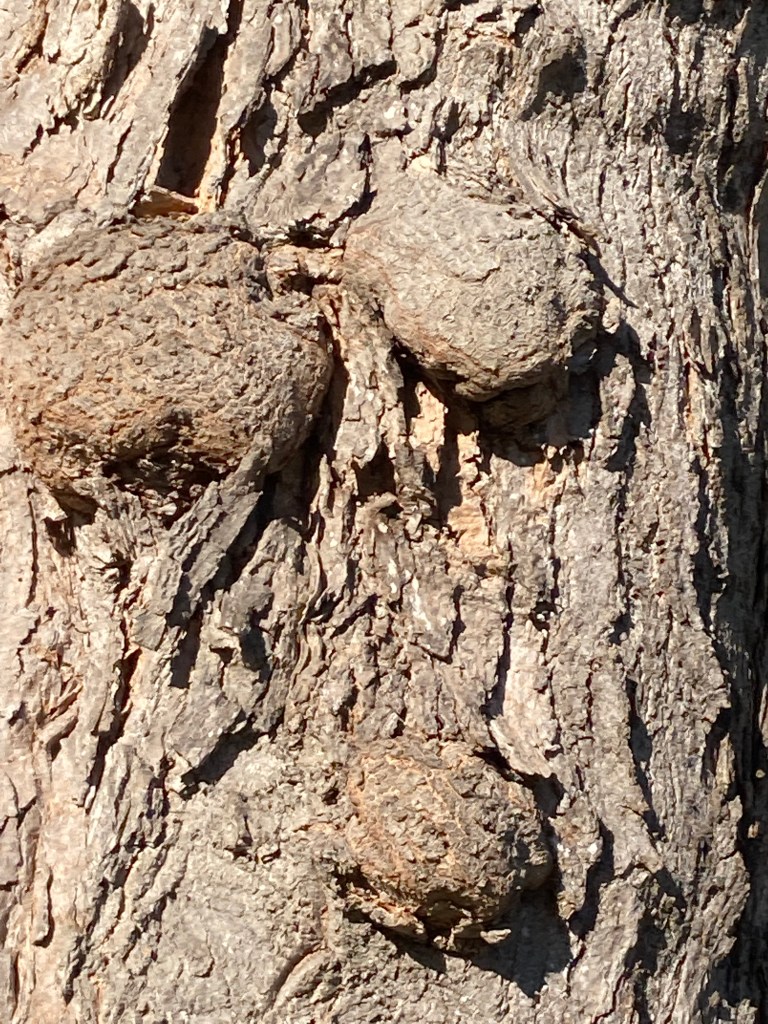
AND: Here is the “Tree of the Week”:
“Feeling a tiny bit Bashful”Fall flower at Hofstra University– New York
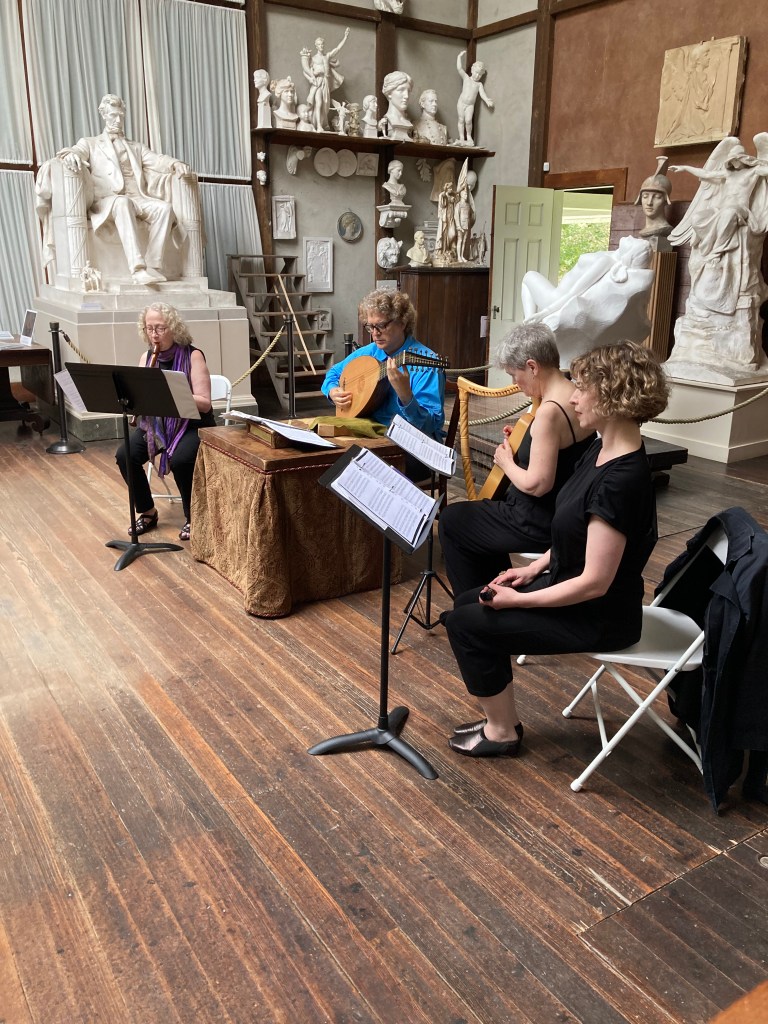
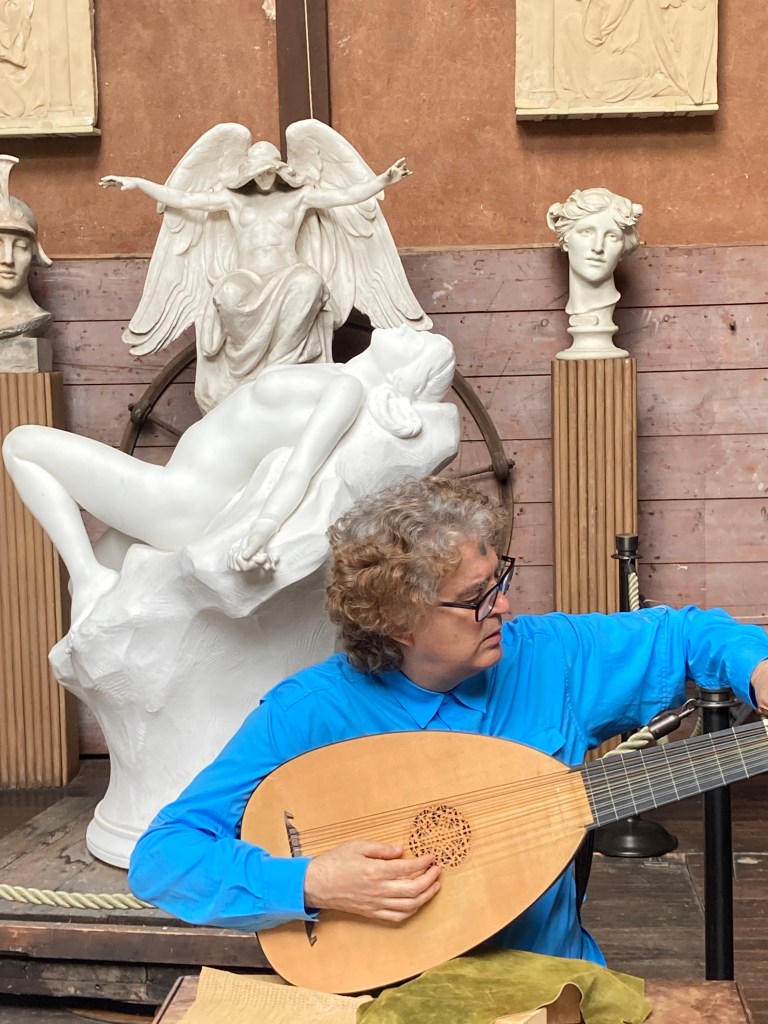
What a pleasure it was to perform a concert at the end of August with my group, The Salisbury Four at Chesterwood, located in Stockbridge, Massachusetts. For many years we have presented an annual Holiday concert for the Salisbury Association in Salisbury, Connecticut.
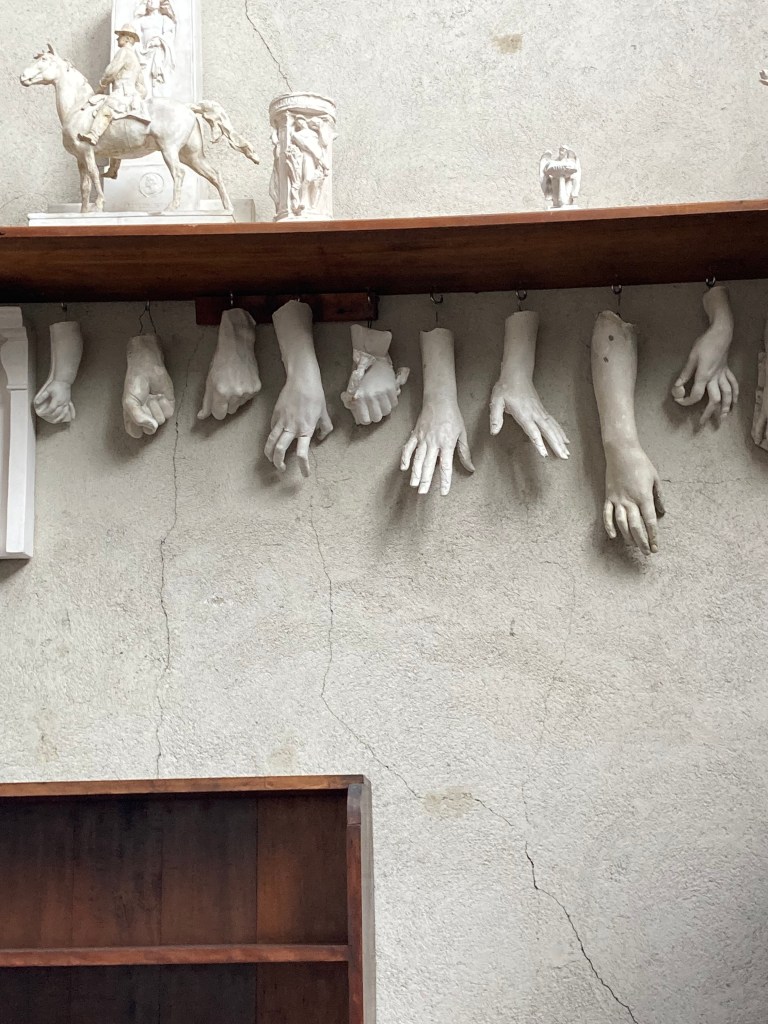
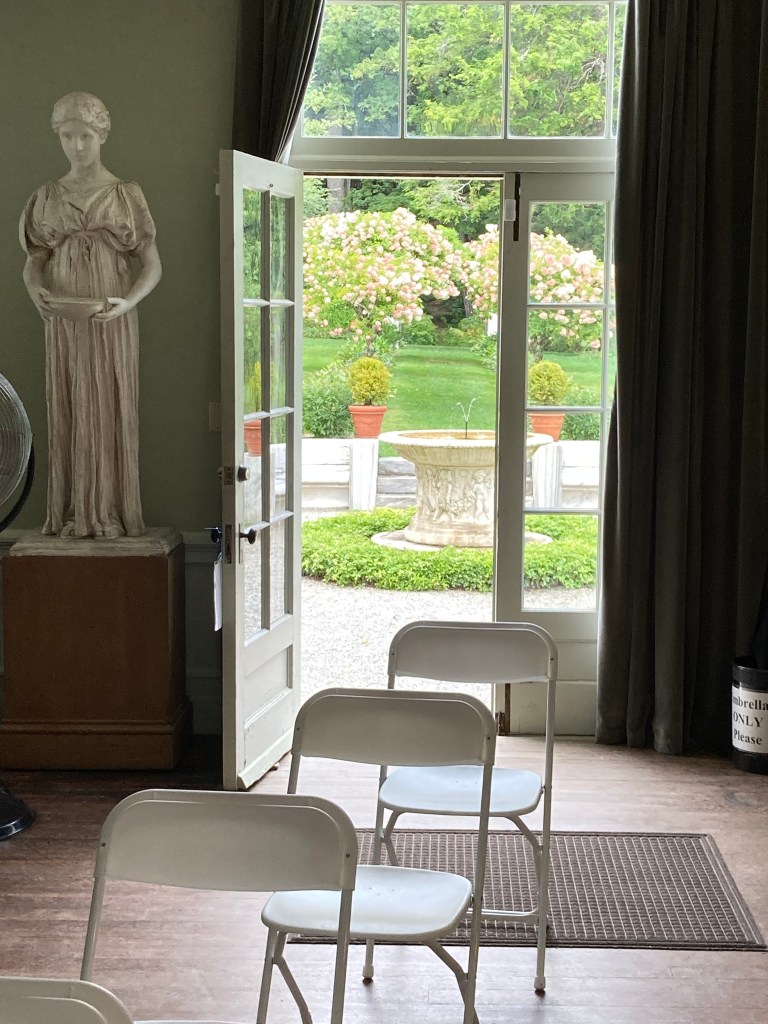
Chesterwood was the home, studio and gardens of America’s foremost public monument sculptor Daniel Chester French who lived from 1850-1931. French is most famous as the sculptor of the Lincoln Memorial. The concert was held in the artist’s spacious studio that had high vaulted ceilings It was thrilling to sit next to studies of Lincoln’s hands and of the Lincoln sculpture!
The studio opens up onto a lovely peaceful garden and the large wrap around porch overlooks Monument Mountain in Great Barrington, Massachusetts!
Our repertoire for lute, recorder, voices, historical harp and Baroque dance has expanded to include a new summer themed program; with our recent concert titled: “Fortune, Love and Time”. We are so fortunate that one of our singers, Zahra Brown, is also a gifted dancer and is a specialist in Baroque dance. Enjoy this short video of our warmup rehearsal!
The other Salisbury Four members are all food lovers and are talented cooks and bakers. When we rehearse at our singer and harpist Marcia Young’s apartment, she always has a wide assortment of unusual teas at the ready and often a freshly baked goody such as a lemon drizzle cake. Another person once brought a rich chocolate babka.
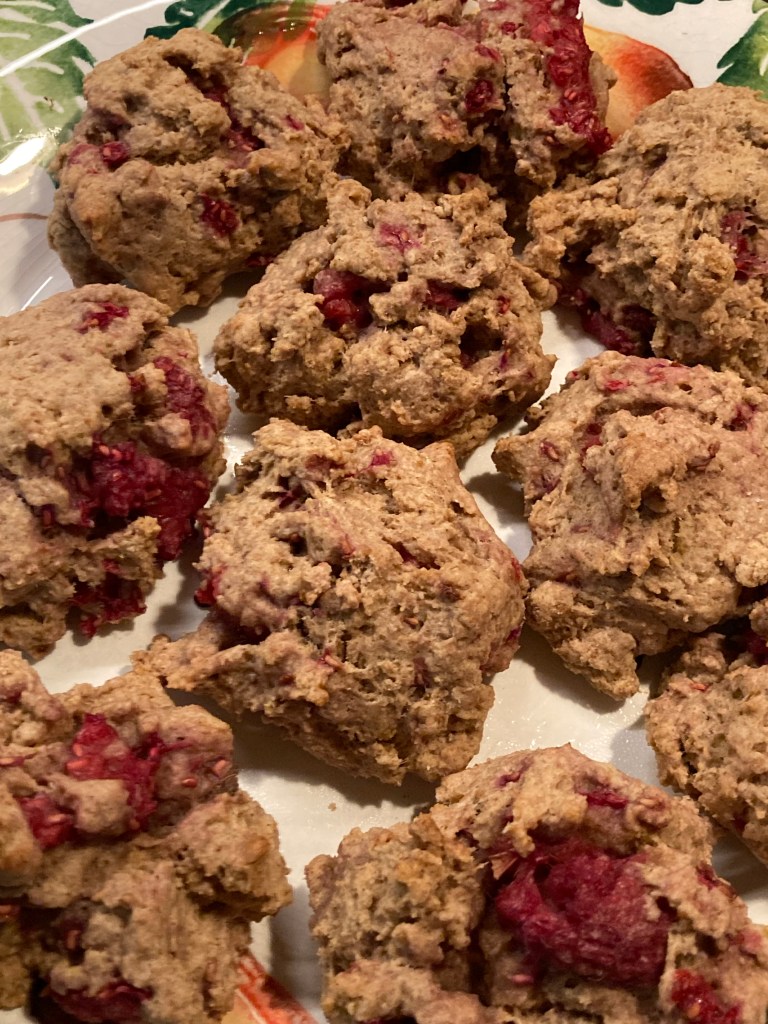
I often make spelt raspberry scones that are super easy to make with a nutty delicious flavor and they also happen be healthy! I planned to bring a plate to the concert and our lutenist Christopher Morrongiello mentioned that he was thinking about the scones a bit obsessively on his long ride up from Long Island!
I have been using this vegan recipe for spelt scones from Erin McKennas’s Baby Cakes cookbook for several years; the dough for the scones, without the sweeteners also make a great topping for either savory potpies or fruit cobblers. I substitute coconut sugar for the agave syrup used in the original recipe.
Spelt Raspberry Scones
Preheat oven to 375 degrees
Ingredients:
1 cup whole wheat pastry flour
1 cup whole grain spelt flour
1/4 cup coconut sugar
1 teaspoon salt
1 teaspoon ground cinnamon
1 tablespoon baking powder
2 teaspoons vanilla extract
1/3 cup canola oil
1/3 cup hot water
To Make Scones:
In a large bowl, combine flours, salt, cinnamon baking powder. Mix well.
Add oil, vanilla and hot water, stir to combine and knead mixture gently a few times with your hands. Lightly stir in raspberries. You could also use blueberries or add chopped walnuts.

































































 A Musician's Travels